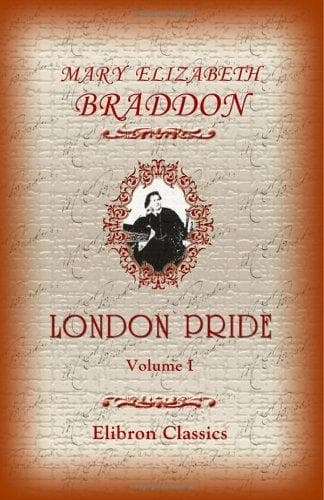
London Pride, Or, When the World Was YoungerBraddon, M. E. (Mary Elizabeth)
History
London Pride, Or, When the World Was Younger
Braddon, M. E. (Mary Elizabeth)
Great Britain -- History -- Charles II, 1660-1685 -- Fiction; London (England) -- Fiction
Lady Kirkland, the only daughter of the Marquise de Montrond, one of
Queen Henrietta Maria’s ladies-in-waiting, had been a papist, and,
although Sir John had adhered steadfastly to the principles of the
Reformed Church, he had promised his bride, and the Marquise, her
mother, that if their nuptials were blessed with offspring, their
children should be educated in the Roman faith—a promise difficult of
performance in a land where a stormy tide ran high against Rome, and
where Popery was a scarlet spectre that alarmed the ignorant and
maddened the bigoted. And now, duly provided with a safe conduct from
the regicide, Bradshaw, he was journeying to the city where he was to
part with his daughter for an indefinite period. He had seen but little
of her, and yet it seemed as hard to part thus as if she had prattled
at his knees and nestled in his arms every day of her young life.
At last across the distance, against the wind-driven clouds of that
stormy winter sky, John Kirkland saw the lights of the city—not many
lights or brilliant of their kind, but a glimmer here and there—and
behind the glimmer the dark bulk of masonry, roofs, steeples,
watch-towers, bridges.
The carriage stopped at one of the gates of the city, and there were
questions asked and answered, and papers shown, but there was no
obstacle to the entrance of the travellers. The name of the Ursuline
Convent acted like a charm, for Louvain was papist to the core in these
days of Spanish dominion. It had been a city of refuge nearly a hundred
years ago for all that was truest and bravest and noblest among English
Roman Catholics, in the cruel days of Queen Elizabeth, and Englishmen
had become the leading spirits of the University there, and had
attracted the youth of Romanist England to the sober old Flemish town,
before the establishment of Dr. Allan’s rival seminary at Douai, Sir
John could have found no safer haven for his little ewe lamb.
The tired horses blundered heavily along the stony streets, and crossed
more than one bridge. The town seemed pervaded by water, a deep narrow
stream like a canal, on which the houses looked, as if in feeble
mockery of Venice—houses with steep crow-step gables, some of them
richly decorated; narrow windows for the most part dark, but with here
and there the yellow light of lamp or candle.
The convent faced a broad open square, and had a large walled garden in
its rear. The coach stopped in front of a handsome doorway, and after
the travellers had been scrutinised and interrogated by the portress
through an opening in the door, they were admitted into a spacious
hall, paved with black and white marble, and adorned with a statue of
the Virgin Mother, and thence to a parlour dimly lighted by a small oil
lamp, where they waited for about ten minutes, the little girl
shivering with cold, before the Superior appeared.
She was a tall woman, advanced in years, with a handsome, but
melancholy countenance. She greeted the cavalier as a familiar friend.
Public-domain text, read in full here on John Shaqi.
Reviews
Reviews
No reviews yet
Be the first to share your thoughts on this work.
Join the Discussion
Join the discussion
Sign in to leave a comment or review.
Sign InorCreate an account