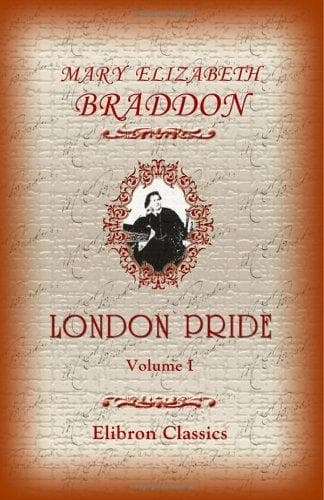
London Pride, Or, When the World Was YoungerBraddon, M. E. (Mary Elizabeth)
History
London Pride, Or, When the World Was Younger
Braddon, M. E. (Mary Elizabeth)
Great Britain -- History -- Charles II, 1660-1685 -- Fiction; London (England) -- Fiction
“Yes, I remember the Abbey, though it looked different then. I saw it
through a cloud of falling snow. It was all faint and dim there. There
were soldiers in the streets, and it was bitter cold; and my father sat
in the coach with his elbows on his knees and his face hidden in his
hands. And when I spoke to him, and tried to pull his hands away—for I
was afraid of that hidden face—he shook me off and groaned aloud. Oh,
such a harrowing groan! I should have thought him mad had I known what
madness meant; but I know not what I thought. I remember only that I
was frightened. And later, when I asked him why he was sorry, he said
it was for the King.”
“Ay, poor King! We have all supped full of sorrow for his sake. We have
cursed and hated his enemies, and drawn and quartered their vile
carcases, and have dug them out of the darkness where the worms were
eating them. We have been distraught with indignation, cruel in our
fury; and I look back to-day, after fifteen years, and see but too
clearly now that Charles Stuart’s death lies at one man’s door.”
“At Cromwell’s? At Bradshaw’s?”
“No, child; at his own. Cromwell would have never been heard of, save
in Huntingdon Market-place, as a God-fearing yeoman, had Charles been
strong and true. The King’s weakness was Cromwell’s opportunity. He dug
his own grave with false promises, with shilly-shally, with an
inimitable talent for always doing the wrong thing and choosing the
wrong road. Open not so wide those reproachful eyes. Oh, I grant you,
he was a noble king, a king of kings to walk in a royal procession, to
sit upon a daïs under a velvet and gold canopy, to receive ambassadors,
and patronise foreign painters, and fulfil all that is splendid and
stately in ideal kingship. He was an adoring husband—confiding to
simplicity—a kind father, a fond friend, though never a firm one.”
“Oh, surely, surely you loved him?”
“Not as your father loved him, for I never suffered with him. It was
those who sacrificed the most who loved him best, those who were with
him to the end, long after common sense told them his cause was
hopeless; indeed, I believe my father knew as much at Nottingham, when
that luckless standard was blown down in the tempest. Those who starved
for him, and lay out on barren moors through the cold English nights
for him, and wore their clothes threadbare and their shoes into holes
for him, and left wife and children, and melted their silver and
squandered their gold for him—those are the men who love his memory
dearest, and for whose poor sakes we of the younger generation must
make believe to think him a saint and a martyr.”
“Oh, my lord, say not that you think him a bad man!”
Public-domain text, read in full here on John Shaqi.
Reviews
Reviews
No reviews yet
Be the first to share your thoughts on this work.
Elsewhere in the archive
Join the Discussion
Join the discussion
Sign in to leave a comment or review.
Sign InorCreate an account