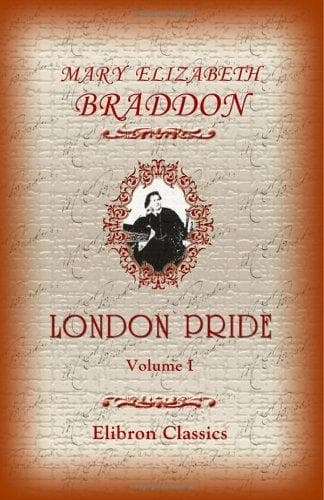
London Pride, Or, When the World Was YoungerBraddon, M. E. (Mary Elizabeth)
History
London Pride, Or, When the World Was Younger
Braddon, M. E. (Mary Elizabeth)
Great Britain -- History -- Charles II, 1660-1685 -- Fiction; London (England) -- Fiction
“What! you think that Omnipotence, in the inaccessible mystery of
Heaven, keeps the muster-roll of earth open before Him, and reckons
each little life as it drops off the list? That is hardly my notion of
Divinity. I see the Almighty rather as the Roman poet saw Him—an
inexorable Father, hurling the thunderbolt our folly has deserved from
His red right hand, yet merciful to stay that hand when we have taken
our punishment meekly. That, Angela, is the nearest my mind can reach
to the idea of a personal God. But do not bend those pencilled brows
with such a sad perplexity. You know, doubtless, that I come of a
Catholic family, and was bred in the old faith. Alas! I have conformed
ill to Church discipline. I am no theologian, nor quite an infidel, and
should be as much at sea in an argument with Hobbes as with Bossuet.
Trouble not thy gentle spirit for my sins of thought or deed. Your
tender care has given me time to repent all my errors. You were going
to tell my lordship something, when I chid you for excess of ceremony—”
“Nay, sir—brother, I had but to say that this wicked Court, of which my
father and you have spoken so ill, can scarcely fail to be turned from
its sins by so terrible a visitation. Those who have looked upon the
city as I saw it a week ago can scarce return with unchastened hearts
to feasting and dancing and idle company.”
“But the beaux and belles of Whitehall have not seen the city as my
brave girl saw it,” cried Fareham.
“They have not met the dead-cart, nor heard the groans of the dying,
nor seen the red cross upon the doors. They made off with the first
rumour of peril. The roads were crowded with their coaches, their
saddle-horses, their furniture and finery; one could scarce command a
post-horse for love or money. ‘A thousand less this week,’ says one.
‘We may be going back to town and have the theatres open again in the
cold weather.’”
They dined at the Crown, at Uxbridge, which was that “fair house at the
end of the town” provided for the meeting of the late King’s
Commissioners with the representatives of the Parliament in the year
’44. Fareham showed his sister-in-law a spacious panelled parlour,
which was that “fair room in the middle of the house” that had been
handsomely dressed up for the Commissioners to sit in.
They pushed on to High Wycombe before night-fall, and supped
_tête-à-tête_ in the best room of the inn, with Fareham’s faithful
Manningtree to bring in the chief dish, and the people of the house to
wait upon them. They were very friendly and happy together, Fareham
telling his companion much of his adventurous life in France, and how
in the first Fronde war he had been on the side of Queen and Minister,
and afterwards, for love and admiration of Condé, had joined the party
of the Princes.
Public-domain text, read in full here on John Shaqi.
Reviews
Reviews
No reviews yet
Be the first to share your thoughts on this work.
Elsewhere in the archive
Join the Discussion
Join the discussion
Sign in to leave a comment or review.
Sign InorCreate an account