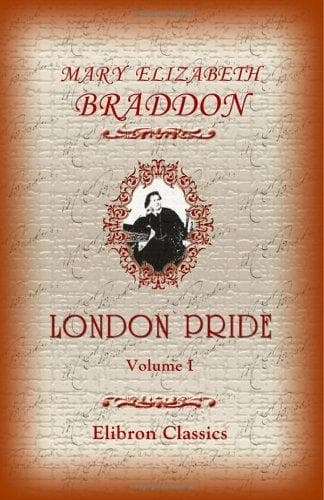
London Pride, Or, When the World Was YoungerBraddon, M. E. (Mary Elizabeth)
History
London Pride, Or, When the World Was Younger
Braddon, M. E. (Mary Elizabeth)
Great Britain -- History -- Charles II, 1660-1685 -- Fiction; London (England) -- Fiction
“Indeed, sister, you are far too generous, and you have overpowered me
with gifts,” she said, when the milliner had curtsied herself out of
the room; “for I fear my own income will never pay for all these costly
things. Three pounds, I think she said, was the price of the Mazarine
hood alone—and there are stockings and gloves innumerable.”
“Mon Ange, while you are with me your own income is but for charities
and vails. I will have it spent for nothing else. You know how rich the
Marquise has made me—while I believe Fareham is a kind of modern
Croesus, though we do not boast of his wealth, for all that is most
substantial in his fortune comes from his mother, whose father was a
great merchant trading with Spain and the Indies, all through James’s
reign, and luckier in the hunt for gold than poor Raleigh. Never must
you talk to me of obligation. Are we not sisters, and was it not a mere
accident that made me the elder, and Madame de Montrond’s _protegée_?”
“I have no words to thank you for so much kindness. I will only say I
am so happy here that I could never have believed there was such full
content on this sinful earth.”
“Wait till we are in London, Angélique. Here we endure existence. It is
only in London that we live.”
“Nay, I believe the country will always please me better than the town.
But, sister, do you not hate that Mrs. Lewin—that horrid painted face
and evil tongue?”
“My dearest child, one hates a milliner for the spoiling of a bodice or
the ill cut of a sleeve—not for her character. I believe Mrs. Lewin’s
is among the worst, and that she has had as many intrigues as Lady
Castlemaine. As for her painting, doubtless she does that to remind her
customers that she sells alabaster powder and ceruse.”
“Nay, if she wants to disgust them with painted faces she has but to
show her own.”
“I grant she lays the stuff on badly. I hope, if I live to have as many
wrinkles, I shall fill them better than she does. Yet who can tell what
a hideous toad she might be in her natural skin? It may be Christian
charity that induces her to paint, and so to spare us the sight of a
monster. She will make thee a beauty, Ange, be sure of that. For satin
or velvet, birthday or gala gowns, nobody can beat her. The wretch has
had thousands of my money, so I ought to know. But for thy riding-habit
and hawking-jacket we want the firmer grip of a man’s hand. Those must
be made by Roget.”
“A Frenchman?”
“Yes, child. One only accepts British workmanship when a Parisian
artist is not to be had. Clever as Lewin is, if I want to eclipse my
dearest enemy on any special occasion I send Manningtree across the
Channel, or ask De Malfort to let his valet—who spends his life in
transit like a king’s messenger—bring me the latest confection from the
Rue de Richelieu.”
“What infinite trouble about a gown—and for you who would look lovely
in anything!”
Public-domain text, read in full here on John Shaqi.
Reviews
Reviews
No reviews yet
Be the first to share your thoughts on this work.
Elsewhere in the archive
Join the Discussion
Join the discussion
Sign in to leave a comment or review.
Sign InorCreate an account