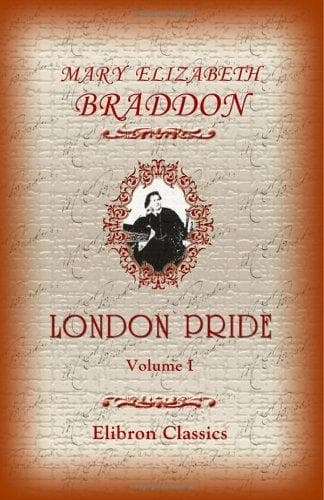
London Pride, Or, When the World Was YoungerBraddon, M. E. (Mary Elizabeth)
History
London Pride, Or, When the World Was Younger
Braddon, M. E. (Mary Elizabeth)
Great Britain -- History -- Charles II, 1660-1685 -- Fiction; London (England) -- Fiction
“Tush, child! You have never seen me in ‘anything.’ If ever you should
surprise me in an ill gown you will see how much the feathers make the
bird. Poets and play-wrights may pretend to believe that we need no
embellishment from art; but the very men who write all that romantic
nonsense are the first to court a well-dressed woman. And there are few
of them who could calculate with any exactness the relation of beauty
to its surroundings. That is why women go deep into debt to their
milliners, and would sooner be dead in well-made graveclothes than
alive in an old-fashioned mantua.”
Angela could not be in her sister’s company for a month without
discovering that Lady Fareham’s whole life was given up to the worship
of the trivial. She was kind, she was amiable, generous, even to
recklessness. She was not irreligious, heard Mass and went to
confession as often as the hard conditions of an alien and jealously
treated Church would allow, had never disputed the truth of any tenet
that was taught her—but of serious views, of an earnest consideration
of life and death, husband and children, Hyacinth Fareham was as
incapable as her ten-year-old daughter. Indeed, it sometimes seemed to
Angela that the child had broader and deeper thoughts than the mother,
and saw her surroundings with a shrewder and clearer eye, despite the
natural frivolity of childhood, and the exuberance of a fine physique.
It was not for the younger sister to teach the elder, nor did Angela
deem herself capable of teaching. Her nature was thoughtful and
earnest: but she lacked that experience of life which can alone give
the thinker a broad and philosophic view of other people’s conduct. She
was still far from the stage of existence in which to understand all is
to pardon all.
She beheld the life about her with wonder and bewilderment. It was so
pleasant, so full of beauty and variety; yet things were said and done
that shocked her. There was nothing in her sister’s own behaviour to
alarm her modesty; but to hear her sister talk of other women’s conduct
outraged all her ideas of decency and virtue. If there were really such
wickedness in the world, women so shameless and vile, was it right that
good women should know of them, that pure lips should speak of their
iniquity?
She was still more shocked when Hyacinth talked of Lady Castlemaine
with a good-humoured indulgence.
“There is something fine about her,” Lady Fareham said one day, “in
spite of her tempers and pranks.”
“What!” cried Angela, aghast, having thought these creatures
unrecognised by any honest woman, “do you know her—that Lady
Castlemaine of whom you have told me such dreadful things?”
Public-domain text, read in full here on John Shaqi.
Reviews
Reviews
No reviews yet
Be the first to share your thoughts on this work.
Elsewhere in the archive
Join the Discussion
Join the discussion
Sign in to leave a comment or review.
Sign InorCreate an account