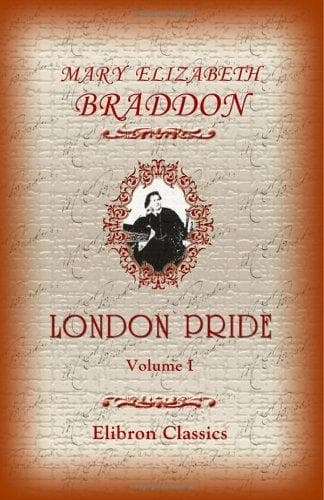
London Pride, Or, When the World Was YoungerBraddon, M. E. (Mary Elizabeth)
History
London Pride, Or, When the World Was Younger
Braddon, M. E. (Mary Elizabeth)
Great Britain -- History -- Charles II, 1660-1685 -- Fiction; London (England) -- Fiction
“C’est vrai. J’en ai dit des raides. Mon Ange, in town one must needs
know everybody, though I doubt that after not returning her visit
t’other day, I shall be in her black books, and in somebody else’s. She
has never been one of my intimates. If I were often at Whitehall, I
should have to be friends with her. But Fareham is jealous of Court
influences; and I am only allowed to appear on gala nights—perhaps not
a half-dozen times in a season. There is a distinction in not showing
one’s self often; but it is provoking to hear of the frolics and
jollities which go on every day and every night, and from which I am
banished. It mattered little while the Queen-mother was at Somerset
House, for her Court ranked higher—and was certainly more refined in
its splendour—than her son’s ragamuffin herd. But now she is gone, I
shall miss our intellectual _milieu_, and wish myself in the Rue St.
Thomas du Louvre, where the Hôtel du Rambouillet, even in its decline,
offers a finer style of company than anything you will see in England.”
“Sister, I fear you left half your heart in France.”
“Nay, sweet; perhaps some of it has followed me,” answered Hyacinth,
with a blush and an enigmatic smile. “_Peste_! I am not a woman to make
a fuss about hearts! There is not a grain of tragedy in my composition.
I am like that girl in the play we saw at Oxford t’other day.
Fletcher’s was it, or Shakespeare’s? ‘A star danced, and under that was
I born.’ Yes, I was born under a dancing star; and I shall never break
my heart—for love.”
“But you regret Paris?”
“_Hélas_! Paris means my girlhood; and were you to take me back there
to-morrow you could not make me seventeen again—and so where’s the use?
I should see wrinkles in the faces of my friends; and should know that
they were seeing the same ugly lines in mine. Indeed, Ange, I think it
is my youth I sigh for rather than the friends I lived with. They were
such merry days: battles and sieges in the provinces, parliaments
disputing here and there; Condé in and out of prison—now the King’s
loyal servant, now in arms against him; swords clashing, cannon roaring
under our very windows; alarm bells pealing, cries of fire, barricades
in the streets; and amidst it all, lute and theorbo, _bouts rimés_ and
madrigals, dancing and play-acting, and foolish practical jests! One
could not take the smallest step in life but one of the wits would make
a song about it. Oh, it was a boisterous time! And we were all mad, I
think; so lightly did we reckon life and death, even when the cannon
slew some of our noblest, and the finest saloons were hung with black.
You have done less than live, Angélique, not to have lived in that
time.”
Public-domain text, read in full here on John Shaqi.
Reviews
Reviews
No reviews yet
Be the first to share your thoughts on this work.
Elsewhere in the archive
Join the Discussion
Join the discussion
Sign in to leave a comment or review.
Sign InorCreate an account