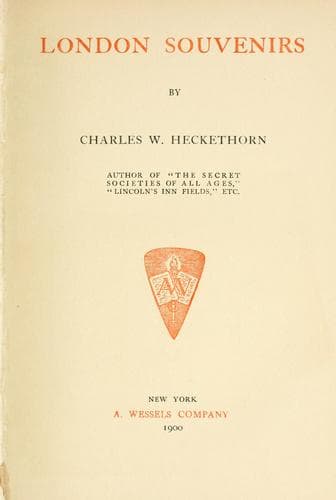
London (England) -- Description and travel; London (England) -- History -- 1800-1950
Abernethy had imitators, but they had been pupils of his. Tommy
Wormald, or ’Old Tommy,’ as the students called him, was Abernethy over
again in voice, style, appearance and humour. To an insurance company
he reported on a bad life proposed to them: ’Done for.’ When an
apothecary wanted to put him off with a single guinea at a consultation
on a rich man’s case, he said: ’A guinea is a lean fee, and the patient
is a fat patient. I always have fat fees from fat patients. Pay me two
guineas instantly; our patient is a fat patient.’ Some rich but mean
people would drive to St. Bartholomew’s to get advice gratis as
out-patients. To this Tommy meant to put a stop. Seeing a lady dressed
in silk, he thus addressed her before a roomful of people: ’Madam, this
charity is for the poor, destitute invalids; I refuse to pay attention
to destitute invalids who wear rich silk dresses.’ The lady quickly
disappeared. Will no Old Tommy arise at the present day and put an end
to the abuse, which is as rampant as ever?
Doctors are not agreed as to what constitutes medical science. By an
empiric a quack is meant. Now, an empiric goes by observation only,
without rational grounds; yet Sir Charles Bell asserted that physiology
was a science of observation rather than of experiment, which is the
rational ground the quack is said to disregard. Who is right? Without
attempting to answer the question, which would lead us too far, we must
rest satisfied with the fact that the profession and the public have
agreed to stigmatize certain individuals as quacks who, with or without
any medical training, pretend to cure diseases by charms, manipulations,
or nostrums, which have no scientific or rational basis. Quacks have
existed at all times, for mankind, especially suffering mankind, has
ever been credulous. Henry VIII. endeavoured to put down those of his
own times by establishing censors in physic, but the public would not be
enlightened, and so the quacks flourished. In 1387 one Roger Clerk, of
Wandsworth, pretending to be a physician, got twelve pence in part
payment from one Roger atte Haccke, in Ironmonger Lane, for undertaking
the cure of his wife, who was ill. He put a charm, consisting of a
piece of parchment, round her neck, but it did her no good, whereupon
Roger brought him before the chamber at Guildhall for his deceit and
falsehood, and Roger Clerk was sentenced to be led through the middle of
the city with trumpets and pipes, he riding on a horse without a saddle,
the said parchment and a whetstone[#] for his lies being hung about his
neck, a urinal also being hung before him, and another on his back. In
the reign of Edward VI. one Grig, a poulterer in Surrey, was set in the
pillory at Croydon, and again in the Borough, for cheating people out of
their money by pretending to cure them by charms or by only looking at
the patient.
Public-domain text, read in full here on John Shaqi.
Reviews
Reviews
No reviews yet
Be the first to share your thoughts on this work.
Elsewhere in the archive
Join the Discussion
Join the discussion
Sign in to leave a comment or review.
Sign InorCreate an account