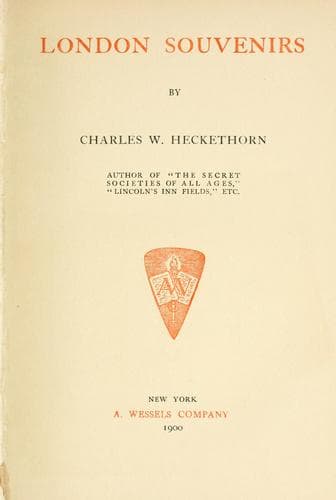
London (England) -- Description and travel; London (England) -- History -- 1800-1950
[#] Early in English history we find the whetstone as the symbol of a
liar. Why? Does lying imply a sharpened wit, as a whetstone sharpens a
blade? The custom is referred to in ’Hudibras,’ II., i. 57-60.
Was Valentine Greatrakes, whom Charles II. invited to his Court, a
quack? If he was, he was a harmless one, since he gave no physic, but
only pretended to cure by magnetic stroking. Our modern magnetizers are
not so modest; they have added much hocus-pocus to Valentine’s simple
process.
From among the medical oddities of the latter part of the last century
we must not omit Dr. Von Butchell, who lived in Mount Street, and
pretended to cure every disease. He applied for the post of dentist to
George III., but when the King’s consent was obtained he said he did not
care for the custom of royalty. When his wife died, he had her embalmed
and kept in his parlour, where he allowed his patients to see the body;
so that the modern showman who exhibited the dead body of his wife at
Olympia was, after all, only a copyist. But whilst the doctor was
half-mad, the world was altogether mad; for his exhibiting the corpse of
his wife was not considered as eccentric as his letting his beard grow,
which then was held to be the height of madness. And there seems to
have been method in _his_ madness, for he sold the hairs out of his
beard at a guinea each to ladies who wished to have fine children. He
used to ride about the West End on a pony painted with spots by the
doctor himself. There is an engraving extant of him, showing him
astride on it. The horse was afterwards, in consequence of a dispute
with the stable-keeper who had charge of it, sold at Tattersall’s,
where, as a curiosity, it fetched a good price. There was a wonderful
inscription on the outside of his house, extending over the front of the
next, and his neighbour rebuilding his frontage, half the inscription
was obliterated. Butchell was also a great advertiser, and his
advertisements even now afford amusing reading. He never would visit a
patient, though as much as £500 was offered him for a visit—patients had
to go to his house. ’I go to none,’ he said in his advertisements. Many
persons used to visit him, not for getting advice, but simply to
converse with such an original. He was twice married. His first wife
he dressed in black, and his second in white, never allowing a change of
colour. He was one of the earliest teetotalers. The profits he and some
of his contemporaries made on their quack draughts and pills led, in
1788, to the imposition of the tax on ’patent medicines.’
Public-domain text, read in full here on John Shaqi.
Reviews
Reviews
No reviews yet
Be the first to share your thoughts on this work.
Elsewhere in the archive
Join the Discussion
Join the discussion
Sign in to leave a comment or review.
Sign InorCreate an account