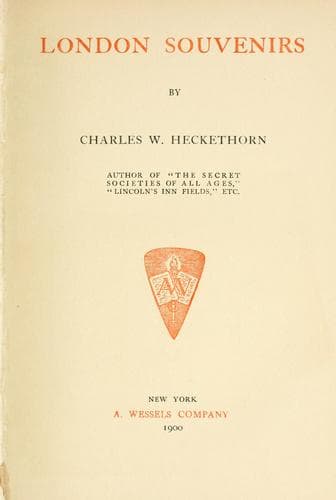
London (England) -- Description and travel; London (England) -- History -- 1800-1950
The most pungent and most witty definition of the doctor’s character
probably is that given, I think, by Talleyrand. When Napoleon, in a fit
of despondency, said that he would forsake war and turn physician, the
sarcastic courtier said _sotto voce_: ’_Toujours assassin?_’
*XV.*
*THE LOST RIVERS OF LONDON.*
London is deficient in two conditions to render it picturesque: it lacks
diversity of surface, and it lacks water. In so vast an expanse of
ground as is covered by London, Ludgate Hill and Notting Hill are mere
molehills.[#] As to water, it has the Thames, but that is accessible at
short and broken intervals only. There is the Embankment from
Blackfriars to Westminster; a short bit at Chelsea, and the Albert
Embankment. But the City people during the day have no time to waste on
their Embankment, and in the evening they are gone to the suburbs, and
so this grand promenade is given up to occasional country cousins’
visits, and to permanent ruffianism. For, of course, no one from the
more northern parts of London ever thinks of coming so far to take a
stroll on that Embankment, from which nothing is to be seen but
mud-banks in the near prospect, as by a perverse arrangement of nature
it is generally low water when you want to take a walk; on the opposite
bank only dismal wharves present themselves. As to the Chelsea
Embankment, that is patronized by the dwellers in that region only, if
they do not neglect it altogether, as people generally do who live in a
rather picturesque locality. The less we say about the Albert
Embankment the better; its characteristics are dingy hovels and
smoke-belching pottery chimneys on one side, smoke and cinders from
passing steam-barges and penny steamers on the river, and a dreary
outlook on the opposite side, scarcely relieved by the Tate Gallery,
which, for reasons unknown to the general public, but self-evident to
those who can see the wire-pulling behind, has been pitched, like a King
Log, into the Pimlico swamp. All other parts of the river are
inaccessible to the public, and therefore as good as non-existent for
the Londoner.
[#] The highest point north is Hampstead Hill, 400 feet above sea-level;
to the south Sydenham Hill, 365 feet; Primrose Hill, about 260 feet;
Herne Hill, about 180 feet; Denmark, about 100 feet; Orme Square, 95
feet; Broad Walk, 90 feet; North Audley Street, 83 feet; Tottenham Court
Road, 85 feet; Regent Circus, 90 feet; Cornhill, 60 feet; Charing Cross,
24 feet; Euston Road, 90 feet; Cheapside, 59 feet; Farringdon Street, 28
feet; St. Katherine’s, Regent’s Park, 120 feet; Camberwell Green, 19
feet.
Public-domain text, read in full here on John Shaqi.
Reviews
Reviews
No reviews yet
Be the first to share your thoughts on this work.
Elsewhere in the archive