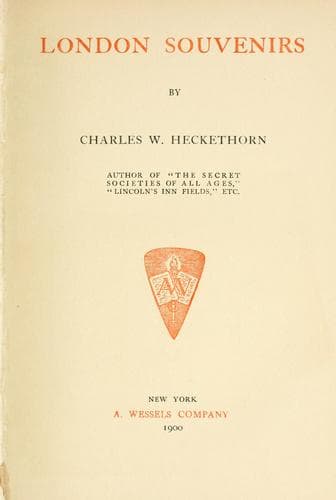
London (England) -- Description and travel; London (England) -- History -- 1800-1950
But to come down to more recent times, in 1700 one John Pechey, living
at the Angel and Crown, in Basing Lane, an Oxford graduate and member of
the College of Physicians, London, advertised that all sick people might
for sixpence have a faithful account of their diseases and plain
directions for their cure, and that he was prepared to visit any sick
person in London for 2s. 6d.; and that if he were called by any person
as he passed by, he would require but one shilling for his advice. A
physician who in our day advertised like this would be deprived of his
diploma. In 1734 one Joshua Ward became a celebrity even among quacks
by his pills, which he extensively advertised, and which were patronized
by the Queen herself. There was a rhyming quack, Dr. Hill, who also
wrote a farce, and wanted Garrick to produce it, till the latter
published the following distich on him:
’For farces and physic his equal there scarce is,
His farces are physic, his physic a farce is.’
A Dr. Hannes, a contemporary of Dr. Radcliffe, ordered his servant to
stop a number of coaches between Whitehall and the Royal Exchange, and
to inquire at each whether it belonged to Dr. Hannes, as he was called
to a patient. Entering Garraway’s Coffee-House, the servant put the
same question. Dr. Radcliffe happening to be there, he asked who wanted
Dr. Hannes. The servant named several lords who all wanted him. ’No,
no, friend,’ said Radcliffe; ’Dr. Hannes wants the lords.’
Quacks were never more flourishing than they are now, and they always
will be, for the public like mysterious remedies, and are anxious to
recommend them and to force them on their friends. In nothing is a
little knowledge more dangerous than in medicine; mothers and nurses
especially, who have acquired some smattering of it from their
conversations with doctors, may do a lot of mischief. To them are due
nearly all so-called diseases of children—as if children must
necessarily have diseases—a superstition which is shared by some
doctors, who also encourage the reading of their books. The reading of
those books has physically the same effect on the body that the reading
or hearing of ghost stories has morally on the mind: the reader or
hearer everywhere feels dis-ease and sees ghosts; _ergo_ beware of
medical books and goblin stories—both are unwholesome. Modern invalids
are fortunate in escaping the tortures inflicted on patients in earlier
days. Edmund Verney thus writes concerning his father, Sir Ralph
Verney, of Claydon House, in 1686: ’He hath been blooded, vomited,
blistered, cupt and scarified, and hath three physicians with him,
besides apothecary and chirurgian.’ And then he wonders that ’he still
continues very weak.’ The marvel was that he survived at all. Had not
Molière a few years before the above date said: ’You must not say that a
man died of such and such a disease, but of so many physicians, surgeons
and apothecaries’?
Public-domain text, read in full here on John Shaqi.
Reviews
Reviews
No reviews yet
Be the first to share your thoughts on this work.
Elsewhere in the archive
Join the Discussion
Join the discussion
Sign in to leave a comment or review.
Sign InorCreate an account