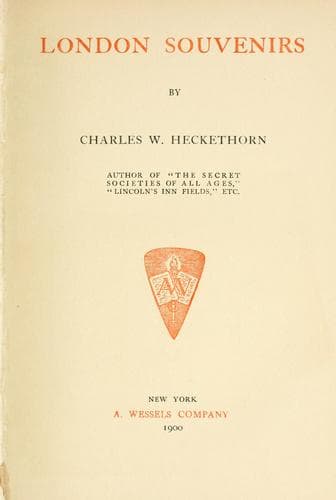
London (England) -- Description and travel; London (England) -- History -- 1800-1950
Here we take our leave of the Fleet, and proceeding westward, find
nothing to arrest our steps till we come to a spot which once went by
the name of the Strand Bridge; not Waterloo Bridge, which originally was
so called, but a ’fair bridge,’ as Stow calls it, erected many hundred
years ago over a brook which crossed the Strand opposite to the present
Strand Lane, and descended from the ponds in Fickett’s Fields, part of
Lincoln’s Inn Fields, now all built over. This bridge probably
disappeared about the year 1550, when an Act was passed for paving the
streets east and west of Temple Bar, and ’Strand Bridge’ is specially
mentioned in the Act; the paving of the Strand seems to have done away
with the brook and the bridge over it. The name of Strand Bridge was
also given to the landing-stage at the bottom of Strand Lane, which
descends in a tortuous line from the Strand down to the Thames. In this
lane there is at the present day the old Roman bath, which, it is
supposed, is supplied from the well which gave its name to Holywell
Street, and which supply never fails.
There are no written records or other traces of any brook descending
from the northern heights through London west of the Strand, till we
come to the Tyburn.
This brook, like the Fleet, took its rise near Hampstead, but turning
westward, and receiving several tributary streamlets, it ran due south
through the Regent’s Park, where it was joined by another affluent from
the site of the present Zoological Gardens, from which point it turned
to the west and crossed the Marylebone Road opposite Gloucester Terrace,
and after running parallel with it for a short distance it took a sharp
turn to the east, following the hollow in which the present Marylebone
Lane stands, the windings of which indicate the course of the brook. On
reaching the southern end of High Street, it again turned to the south,
crossed Oxford Street, ran down part of South Molton Street, turned west
again to the south of Berkeley Square; thence it flowed through the
narrow passage between the gardens of Lansdowne House and Devonshire
House, whose hollow sound seems to indicate the existence of the
watercourse below. It next crossed Piccadilly, ran due south through
the Green Park, passed under Buckingham Palace, directly after which it
divided into three branches, one of which ran through the ornamental
water in St. James’s Park, whence it fell into the Thames: the middle
branch ran into the ancient Abbey at Westminster, where it turned the
mills the monks had erected there. But from old maps it appears that
this arm of the Tyburn, at a point a little north-west of the Abbey,
threw out a branch which in a northerly course rejoined the park, and
then in a curved line to the east reached the Thames at a point not far
from Westminster Bridge, and to the north-east of it. The spot where
this branch touched St. James’s Park was close to Storey’s Gate. Now
Public-domain text, read in full here on John Shaqi.
Reviews
Reviews
No reviews yet
Be the first to share your thoughts on this work.
Elsewhere in the archive
Join the Discussion
Join the discussion
Sign in to leave a comment or review.
Sign InorCreate an account