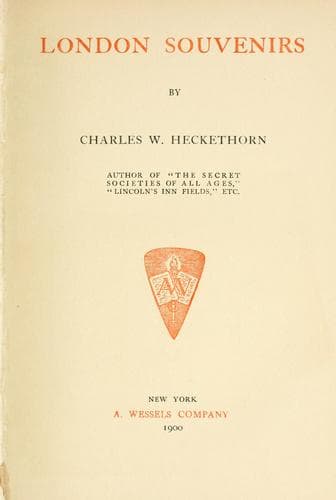
London (England) -- Description and travel; London (England) -- History -- 1800-1950
last year (1898) when the ground was being excavated for the foundations
of the new Institute of Mechanical Engineers, the workmen came upon the
piles and brickwork of an ancient wharf. The structure was wonderfully
well preserved; it had evidently been well constructed, probably by the
monks, and may have been for the accommodation of the fishermen bringing
their goods to the monastery. But at present, and until further
information is obtained, if ever it is obtained, we can only form
conjectures as to the purposes of the wharf; but its discovery on that
spot is curiously illustrative of the history which still lies hidden
under our streets.
We have yet to mention the third branch of the Tyburn, which started
south of Buckingham Palace. It ran in a southerly direction across
Victoria Street, for a short distance skirted the Vauxhall Bridge Road,
then crossed it and ran through the marshy grounds then existing down to
the Thames a little to the west of Vauxhall Bridge.
Such was the course of the Tyburn. Of the bridges that once must have
crossed it not a vestige remains; but we have the record of one which
was at the spot which is now Stratford Place, and where the Lord Mayor’s
Banqueting-house stood, to which he resorted when he, the Aldermen, and
other distinguished citizens went to inspect the head conduits from
which the City conduits were supplied, on which occasions they combined
pleasure with business, hunting the hare before and the fox after
dinner. The Tyburn must at one time have been a stream of considerable
size; in the year 1238 it was so copious as to furnish nine conduits for
supplying the City with water. It had rows of elms growing on its
banks, and as it generally, but erroneously, is supposed to have flowed
past the southern corner of the Edgware Road, the name of Elm Place was
given to a street (now pulled down) west of Connaught Place. How this
error arose we shall show when speaking of the West Bourne. On the
Tyburn stood the church of St. Mary _la bonne_; by the vulgar omission
of letters ’burn’ became ’bone,’ hence Marylebone. The Tyburn, like the
other brooks already discussed, is now a mere sewer.
Public-domain text, read in full here on John Shaqi.
Reviews
Reviews
No reviews yet
Be the first to share your thoughts on this work.
Elsewhere in the archive
Join the Discussion
Join the discussion
Sign in to leave a comment or review.
Sign InorCreate an account