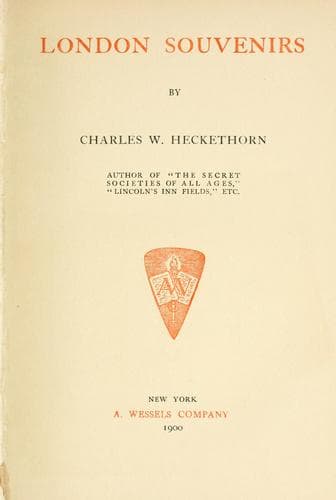
London (England) -- Description and travel; London (England) -- History -- 1800-1950
Here we close our journey and our records at a funeral. Well, the finale
is not inappropriate. Have we not been attending the funerals of so
many gay and bright and sparkling, joyfully leaping and rushing, and
sometimes roaring, brooks and rivers, descending from the sunny
hillsides, finally to be buried in dark and noisome sewers? And the
lost river, alas! is but too often the type of the lost life. But
moralizing is not in our line—we think it sad waste of time; it is no
better than doctors’ prescriptions. We would rather remind the reader,
who in these notes may miss elegance of style and picturesqueness of
description, that such qualities were incompatible with the compactness
of details the space at our command imposed upon us. Besides, a more
florid style must borrow something from imagination; but here we had
only to deal with facts, and if the reader finds as much pleasure in
studying as we did in collecting them, though the labour was great, he
will not regret the time bestowed on their perusal.
*XVI.*
*ROGUES ASSORTED.*
On Horwood’s Map of London, dated 1799, just one hundred years ago,
there is shown a road, starting from Blue Anchor Lane, Bermondsey, at
almost a right angle to the latter, and running in an easterly
direction, but with a considerable curve in it, and this road is called
Rogues’ Lane. It is more than half a mile long, perfectly solitary, not
a house on or near it, the land around it being a wild waste, and as
deserted as a lonely moor in the recesses of Wales or Cornwall. How did
this lane acquire its name? Did the inhabitants of the East End of
London construct it as a kind of sewer for carrying off into the
outlying wilderness the rogues who infested their streets? or did the
rogues of that day, openly or tacitly acknowledging themselves to be
such, choose the lane as a kind of rendezvous, as a sort of peripatetic
exchange for the transaction of their rascally schemes? The East End of
London seems, indeed, in those days, to have been a favourite resort of
rogues—Stepney had its Rogues’ Well—now they prefer the West End. But
the rogues of old were somewhat different from the modern specimens;
they were chiefly thieves, footpads, burglars, sneaks, low cheats, sham
cripples, and such mean fry—modern civilization, with its panacea of
education, had not yet asserted itself. Culture, which licks all the
world into shape, has even reached the rogues; the petty scoundrels of
old are replaced by the magnificent swindlers of the present day, who
deal not in paltry pence, but in weighty sovereigns—who do not cheat a
silly countryman out of the few shillings his purse may contain, but
wheedle trusting spinsters and mad and greedy speculators out of
thousands of pounds. The modern rogue is either a promoter of bogus
companies, or a director who issues bogus shares, an embezzling
bank-manager or trustee, or a man who lives far beyond his means, even
Public-domain text, read in full here on John Shaqi.
Reviews
Reviews
No reviews yet
Be the first to share your thoughts on this work.
Elsewhere in the archive
Join the Discussion
Join the discussion
Sign in to leave a comment or review.
Sign InorCreate an account