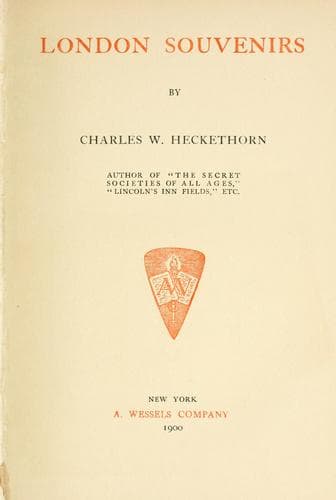
London (England) -- Description and travel; London (England) -- History -- 1800-1950
when he knows that all his available assets are gone in betting, racing,
and Stock Exchange speculation, or a fraudulent bankrupt. And there is
no slitting of noses, no whipping, not even exposure on the pillory
ominously looming at the end of their career; when the game is up, no
more cash to be obtained by loans, and the infuriated creditors become
troublesome, he attempts one more big haul, the proceeds of which, if
successful, he prudently settles on his wife, and then the unfortunate
victim of circumstances, over which, as he pathetically says, he had no
control, leisurely takes a walk to Carey Street, has a comfortable wash
and brush up in the financial lavatory which hospitably stands open
there, and he comes out, thoroughly whitewashed and rid of all
importunate claims upon him, after which he hires a fine mansion in
Belgravia, fares sumptuously every day, and bespatters with the mud of
his chariot-wheels the deluded shareholders and tradespeople whom his
wily schemes have ruined. It is all, or nearly all, the outcome of
modern education, which, by ramming notions totally unsuited to the
minds and characters under tuition into juvenile minds, bears such
bitter fruit. But educational cranks have it all their own way now,
though it is wrong to call them ’educational’; they fancy that education
means ’cramming,’ never mind whether the food is assimilated with the
body, whilst education really means the very opposite—namely, a drawing
out, not a putting in: a drawing out of the hidden properties of mind
and character. But let us come to our theme—the London rogues of old;
their evil deeds were done long ago, and will therefore not rile as does
the rascality we see around us now. We will take the beggars first: not
all beggars are rogues, but the majority are. They fared variously
under various Kings; some protected, some persecuted them. Strange it
is that, under the juvenile, gentle Edward VI., one of the most severe
laws was passed against them: a servant absenting himself for three days
or more from his work was to be, on his re-capture, marked with a hot
iron with the letter V (vagabond), and be his master’s slave for two
years, and fed on bread and water; should he run away again, he was, on
being caught, to be marked on his forehead or cheek with a hot iron with
the letter S (slave), and be his master’s slave for life; for a third
escape the punishment was death. This diabolical law was repealed two
years after. Under Elizabeth sturdy beggars were whipped till the blood
came. James I. rather sympathized with them; he, like them, always was
in need of ’siller.’ Hence the country, and especially London, swarmed
with rogues of every description, known by various cant terms, such as
Rufflers, Upright Men, Hookers, Rogues, Pallyards, Abraham Men, Traters,
Freshwater Mariners or Whipjacks, Dommerars, Swadders, Bawdy Baskets,
Doxies, with many other names of the same slang category; and, of
Public-domain text, read in full here on John Shaqi.
Reviews
Reviews
No reviews yet
Be the first to share your thoughts on this work.
Elsewhere in the archive
Join the Discussion
Join the discussion
Sign in to leave a comment or review.
Sign InorCreate an account