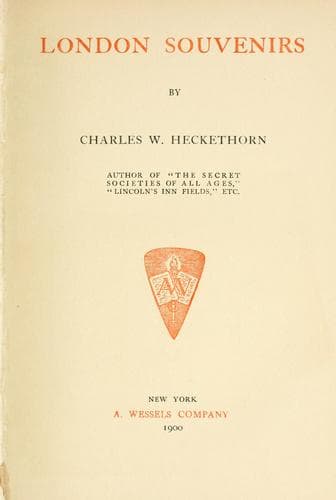
London (England) -- Description and travel; London (England) -- History -- 1800-1950
course, the object of all the members of these various associations was
to cheat the unwary and charitable. In course of time some of these
terms went out of use—the cant of rogues is always on the move—but new
ones took their places; and, in spite of all the laws passed against
them, beggars continued to flourish. In 1728 a spirited presentment to
the Court of King’s Bench was made by the Grand Jury of Middlesex
against the unusual swarms of sturdy and clamorous beggars, as well as
the many frightful objects exposed in the streets; and, the nuisance not
abating, a similar presentment was made in 1741, with the same
unsatisfactory result. And as long as there are people who will not,
and people who cannot, work, and as long as there are thoughtless people
who will indiscriminately give alms, beggars will infest our streets.
Referring to such, Sir Richard Phillips, in his ’Morning’s Walk from
London to Kew’ (1820), tells us that the passage from Charing Cross to
St. James’s Park through Spring Gardens was a favourite haunt of
beggars. Says he: ’A blind woman was brought to her post by a little
boy, who, carelessly leading her against the step of a door, she gave
him a smart box on the ear, and exclaimed, "Damn you, you rascal! can’t
you mind what you are about?" and then, leaning her back against the
wall, in the same breath she began to chaunt a hymn.’ Even now you may
hear a psalm-singing woman, who has hired two or three children to
render the show more effective, when these get weary, growl, in a hoarse
whisper between her Hallelujahs, ’Sing out, ye devils!’ The Rookery in
St. Giles’s, demolished to make room for New Oxford Street, was the very
paradise of beggars. They there held an annual carnival, to which Major
Hanger on one occasion accompanied George IV., when still Prince of
Wales. The chairman, addressing the company, and pointing to the
Prince, said: ’I call upon that ’ere gemman with a shirt for a song.’
The Prince got excused on his friend agreeing to sing for him, who then
sang a ballad called ’The Beggar’s Wedding; or, the Jovial Crew,’ with
great applause. The beggars drank his health, and he and the Prince
soon after managed to make good their retreat.
Among the most infamous rogues of the last century were men of the
Jonathan Wild stamp—_agents provocateurs_, as we should now style
them—who not only led people into crime, but shared the proceeds of it
with the felons; nay, worse, they got persons who were quite innocent
convicted, by perjured witnesses, of crimes which had never been
committed. It was practices like these which at last brought Jonathan
Wild himself to the scaffold.
Public-domain text, read in full here on John Shaqi.
Reviews
Reviews
No reviews yet
Be the first to share your thoughts on this work.
Elsewhere in the archive
Join the Discussion
Join the discussion
Sign in to leave a comment or review.
Sign InorCreate an account