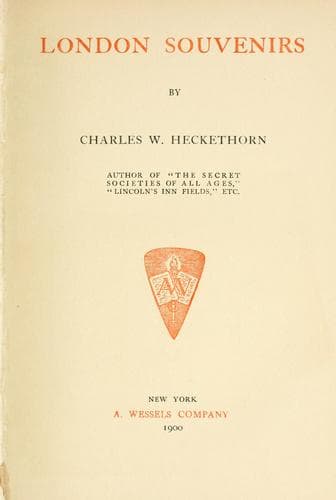
London (England) -- Description and travel; London (England) -- History -- 1800-1950
It is, in fact, still a moot point, and, we suppose, always will be,
what lengths an advocate may go to, consistently with truth and honour,
in pleading the cause of a client whom he knows to be guilty. The
conduct of Charles Phillipps, in defending Courvoisier, has always been
condemned. Courvoisier did not confess his guilt to his counsel, but
admitted to him that he had made away with some plate from Lord William
Russell’s house immediately after the murder. This was damning
evidence, but the communication was made by the prisoner not to admit
his guilt, but merely to prepare his counsel to deal with the evidence.
But Phillipps made a remark in his speech which the Bar considered as
unjustifiable. He said: ’Supposing him to be guilty of the murder,
which is known to God Almighty alone, I hope, for the sake of his
eternal soul, he is innocent.’ These words were not only in bad taste,
but conveyed a positive falsehood. Counsel’s part is to lay before the
jury possibilities, and not his own opinion of the prisoner’s guilt or
innocence; and a strange feature of the etiquette of the Bar is that if
counsel is prepared to throw up his brief because he sees his cause to
be bad, yet he is bound, after accepting the retainer, to continue
defending the case if his client insists on his doing so. He may then
be compelled to go on arguing on behalf of a man whom he knows to be a
thorough scoundrel.
Barristers were first appointed by Edward I. about 1291, but there is an
earlier mention of professional advocates in England, who were of
various ranks, as King’s or Queen’s Counsel, Serjeants, etc. At more
recent dates we read of utter or outer and inner barristers; these terms
appear to have been derived from local arrangements in the halls of the
Inns of Court. In the public meetings held in these halls, the benchers
and readers—superior to barristers—occupying the daïs, which was
separated by a bar, some of the barristers who had attained a certain
standing were called from the body of the hall to the bar—that is, to
the first place outside the bar—for the purpose of arguing doubtful
questions and cases, whence they probably obtained the name of outer
barristers. The course of legal education consisted principally of
readings and mootings. The readings were expositions of important
statutes. These readings being accompanied by costly entertainments,
especially at Lincoln’s Inn, their original object was forgotten in the
splendour of the tables, for which the benchers were severely
reprimanded by Charles I. The readings were eventually suspended, but
were revived about 1796. Mootings were questions on doubtful points of
law, argued between certain of the benchers and barristers in the hall.
There was also another exercise in the Inns of Court, called
’bolting’—not gastronomically—which was a private arguing of cases by
some of the students and barristers. The term was probably derived from
Public-domain text, read in full here on John Shaqi.
Reviews
Reviews
No reviews yet
Be the first to share your thoughts on this work.
Elsewhere in the archive
Join the Discussion
Join the discussion
Sign in to leave a comment or review.
Sign InorCreate an account