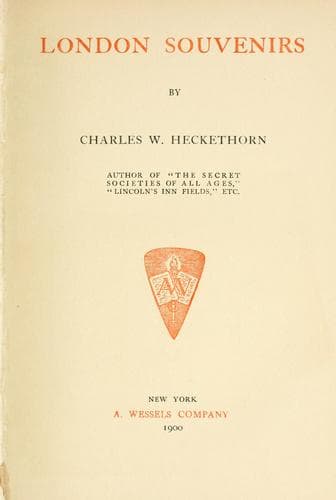
London (England) -- Description and travel; London (England) -- History -- 1800-1950
’bolter,’ a sieve, with reference to the sifting of cases.
As to the fees paid to barristers, how they have altered! In 1500 the
Corporation of Canterbury paid for advice regarding their civic
interests 3s. 4d. to each of three Serjeants, and gave the Recorder of
London 6s. 8d. as a retaining-fee. Five years later Mr. Serjeant Wood
received a fee of 10s. from the Goldsmiths’ Company. In the sixteenth
century it was customary for clients to provide food and drink for their
counsel. In a bill of costs in the reign of Edward IV. we find:
s. d.
For a breakfast at Westminster to our counsel . 1 6
To another time for boat hire and breakfast . . 1 6
In like manner the accountant of St. Margaret’s, Westminster, entered in
the parish books: ’Paid to Roger Fylpott, learned in the law, for his
counsel given, 3s. 8d., with 4d. for his dinner.’
In Elizabeth’s reign, and during the time of her successors, barristers’
fees showed a tendency to increase. Counsel then received 20s. fees,
though 10s. was the usual fee. A ten-shilling piece was then called an
’angel,’ whence arose the witty saying: ’A barrister is like Balaam’s
ass, only speaking when he sees the angel.’ When Francis Bacon was
created King’s Counsel to James I., an annual salary of £40 was assigned
to him; but at present the status of a Q.C. is simply an affair of
professional precedence, to which no fixed emolument is attached. But
Francis Bacon, though he received as his official salary £40 only, made
£6,000 in his profession; other King’s Counsel earned even larger sums
in fees. But the barristers were not all greedy. In the days of Sir
Matthew Hale, professional etiquette permitted clients and counsel to
hold intercourse without the intervention of an attorney. When those
who came to Hale for his advice gave him a sovereign, he used to return
half, saying his fee was 10s. When appointed arbitrator, he would take
no fees, because, as he said, he acted in the capacity of a judge, and a
judge should take no money. If he took bad money, as he often did, he
would not pass it on again, but kept it by him. At last he had a great
heap of it, and his house being once entered by burglars, this
accumulation of bad money attracted their attention, and they carried it
off in preference to other valuables, fancying that this must be the
lawyer’s hoarded treasure.
Public-domain text, read in full here on John Shaqi.
Reviews
Reviews
No reviews yet
Be the first to share your thoughts on this work.
Elsewhere in the archive
Join the Discussion
Join the discussion
Sign in to leave a comment or review.
Sign InorCreate an account