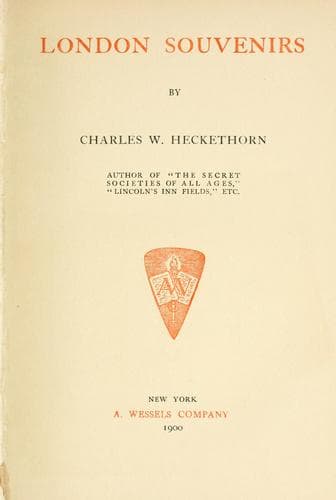
London (England) -- Description and travel; London (England) -- History -- 1800-1950
Readers who wish to know in what estimation lawyers were held in the
seventeenth century should study the pamphlets and broadsides of the
Commonwealth, which show how universal was the belief that wearers of
ermine and gentlemen of the long robe would practise any sort of fraud
or extortion for the sake of personal advantage. How happy we are to
live in this century, when the legal profession is in a state of high
purification! It does, indeed, sometimes surprise an outsider that so
many barristers should be necessary to carry through one case—it looks
as if they were brought in merely for the benefit of the lawyers; but,
in justice to the profession, let us say that this is not so.
Barristers have their special gifts, and a long and involved case brings
them all into play to the advantage of the client. One man has
unrivalled powers of statement; another is sound in law; another excels
in cross-examination; another in reply; another has the ear of the
court, or is all-persuasive with the jury. A barrister, to be
successful at the Bar, needs, indeed, many qualifications. Lord
Brougham states that Mansfield’s powers as an advocate were great; he
possessed an almost surpassing sweetness of voice, and it was said that
his story was worth other men’s arguments, so clear and skilful were his
statements. Concerning Lord Erskine, another famous debater in the
forensic lists, juries declared that they felt it impossible to remove
their looks from him when he had riveted and, as it were, fascinated
them by his first glance; and it used to be a common remark of men, who
observed his motions, that they resembled those of a blood-horse—as
light, as limber, as much betokening strength as speed. His voice was
of surpassing sweetness, clear, flexible, strong, less fitted, indeed,
to express indignation or scorn than pathos. Lord Sandwich, First Lord
of the Admiralty, having brought an action for libel against persons who
had charged him with having appointed landsmen as Greenwich pensioners
to serve his own electioneering purposes, Erskine undertook the defence,
and such was the effect of his speech that, before he left the court,
thirty retainers were presented to him. Fortune comes to those who can
wait. Lord Ellenborough first distinguished himself as the leading
counsel for Warren Hastings, and soon after rose to the head of the
Northern Circuit; Lord Brougham attained his subsequent position by his
defence of Queen Caroline.
Public-domain text, read in full here on John Shaqi.
Reviews
Reviews
No reviews yet
Be the first to share your thoughts on this work.
Elsewhere in the archive
Join the Discussion
Join the discussion
Sign in to leave a comment or review.
Sign InorCreate an account