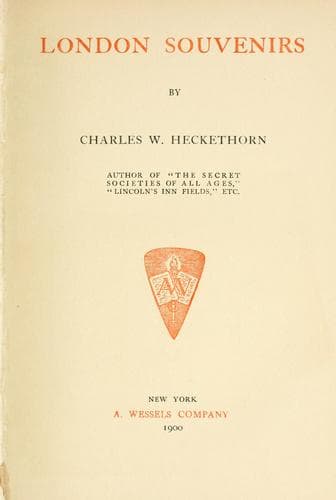
London (England) -- Description and travel; London (England) -- History -- 1800-1950
So he went the next day, prepared
to pay out of his own pocket for another copy of the document. Counsel
honestly said: ’I could not do that, my friend, for to-day I might give
you an opinion totally opposed to the one I gave you yesterday, which
would be awkward if the first should turn up.’
Sometimes consulting counsel will condescend to come into court to argue
some disgustingly technical point about ’contingent remainders’ or
’conveyancing.’ On such occasions they evince unbounded contempt for
the court, whose ignorance necessitates their presence. They will
consume a whole day in dull and dry arguments, and send some judges to
sleep, and those who remain awake after counsel’s speech know less of
the matter than they knew before; their brains are muddled with the
legal rigmarole they have been listening to. The ecclesiastical counsel,
who flourished in the days before the Probate and Divorce Courts were
established, and from ’doctors’ became ’counsel,’ when called out into
the general practice of the new system, were like so many owls suddenly
brought into daylight, Sir Cresswell Cresswell so bedevilled them, and
yet did it so politely that they could not complain.
Barristers had a good time of it in those old days of the Ecclesiastical
Courts; the system of appeal was splendidly organized—the pettiest case
could gradually be raised into one of great importance. There were
courts throughout the country—royal, archiepiscopal, episcopal, decanal,
sub-decanal, prebendal, rectorial, vicarial, and manorial. A case
arises in any one of these courts, and the verdict being unsatisfactory
to one of the parties, he appeals to the courts of the archdeacons and
others, where the case is again heard, decided, and again appealed
against. Poor men, who cannot go on for ever, must stop; but the party
who can afford it goes to the Consistorial Court, where the whole
process of hearing, deciding, and appealing is repeated. The third step
is the Chancellor’s Court; the fourth the Court of Arches. If the
appellant still has some money left, he may go to the Privy
Council—formerly to the Court of Delegates at Doctors’ Commons, now
abolished. This is no mere imaginary case. ’There was a case,’ says
Dr. Nicholls, ’in which the cause had originally commenced in the
Archdeacon’s Court at Totnes, and thence there had been an appeal to the
Court at Exeter, thence to the Arches, and thence to the Delegates; and
the whole question at issue was simply the question which of two persons
had the right of hanging his hat on a particular peg. Fancy, what an
army of barristers must have grown fat on this oyster!’
Public-domain text, read in full here on John Shaqi.
Reviews
Reviews
No reviews yet
Be the first to share your thoughts on this work.
Elsewhere in the archive
Join the Discussion
Join the discussion
Sign in to leave a comment or review.
Sign InorCreate an account