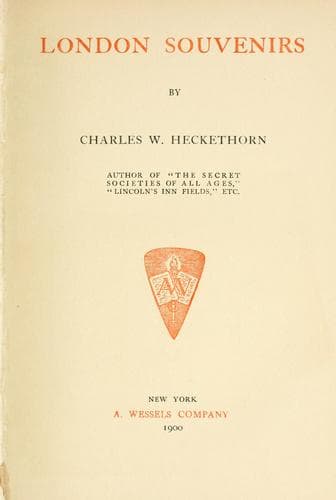
London (England) -- Description and travel; London (England) -- History -- 1800-1950
Success at the Bar comes to barristers in the most capricious manner.
In this profession, as in many other pursuits, modest merit but slowly
makes its way. Manners make the man, but impudence an advocate; without
this latter quality even high connections and powerful patronage often
seem ineffectual. Earl Camden, the son of Chief Justice Pratt, was
called to the Bar in his twenty-fourth year, and remained a briefless
barrister for nine long years, when he resolved to abandon Westminster
Hall for his College Fellowship; but at the solicitation of his friend
Healey, afterwards Lord Chancellor Northington, he consented once more
to go the Western Circuit, and through his kind offices received a brief
as his junior in an important case. His leader’s illness threw the
management of the case into Mr. Pratt’s hands; his success was complete,
and, after many years’ lucrative practice, he was made Attorney-General,
and three years after, in 1762, raised to the Bench as Chief Justice of
the Common Pleas. In 1766 he was made Lord Chancellor, and raised to
the peerage. The Earl of Eldon was on the point of retiring from the
contest for clients, when fortune unexpectedly smiled upon him, and the
records of the Bar are full of similar instances.
We have spoken of cross-examination. Its legitimate object is not to
produce startling effects, but to elicit facts which will support the
theory intended to be put forward; but in most cases the first is aimed
at, and frequently with success. Counsel, however, must perform this
operation with much discretion. To a barrister who was recklessly
asking a number of questions in the hope of getting at something, Mr.
Baron Alderson said: ’You seem to think that the art of
cross-examination consists in examining crossly.’ Judges frequently
give hints to counsel; to one who was terribly long-winded, the judge
said: ’You have stated that before, but you may have forgotten it—it was
so long ago.’ Counsel must not allow himself to be carried away by the
fervour of his oratorical powers, and thus overshoot the mark. Arabin,
the Commissioner, a shrewd, quaint little man, uttered absurdities
without knowing he did so. ’I assure you, gentlemen,’ he one day said
to the jury, ’the inhabitants of Uxbridge will steal the very teeth out
of your mouth as you walk through the streets. _I know it from
experience_.’ When technical expressions are likely to be brought up in
a case before the court, counsel should be careful to get posted up in
them, or he may make a strange and laughable mess of it. A question of
collision between two boats down the river Thames was being
investigated. The master of one of the boats was in the witness-box.
’Now,’ said counsel, cross-examining him, ’what time was it when the
other boat ran into you, as you say?’
’It was during the dog-watch,’ replied the mariner.
Public-domain text, read in full here on John Shaqi.
Reviews
Reviews
No reviews yet
Be the first to share your thoughts on this work.
Elsewhere in the archive
Join the Discussion
Join the discussion
Sign in to leave a comment or review.
Sign InorCreate an account