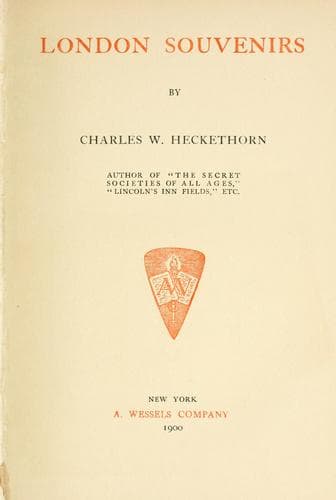
London (England) -- Description and travel; London (England) -- History -- 1800-1950
The profession, as we hardly need remind the reader, has produced many
distinguished characters; to choose from amongst them those most
deserving of praise would be difficult, and perhaps invidious; still,
the actions of those whose conduct has not imparted to them the mere
splendour of passing meteors, but has conferred permanent benefits on
the country, seem to entitle them to a certain pre-eminence. A man
entitled to such pre-eminence and the grateful remembrance of Englishmen
was Sir Samuel Romilly. His father was a jeweller in Frith Street,
Soho; the boy was first placed with a solicitor, then with a merchant,
and finally articled to one of the sworn clerks of Chancery. At the
expiration of his articles he qualified himself for the Bar, but he had
to wait long before he was rewarded with any practice. But when briefs
came, they came in a flood; his income rose to about £9,000 a year. He
was returned to Parliament in 1806 by the electors of Westminster,
without the expenditure of a shilling on his part—a significant fact of
his merits in those days of bribery and corruption. He was also
appointed Solicitor-General and knighted. He distinguished himself in
the House by his speeches in favour of the abolition of the slave trade,
but his great claims to the gratitude of the nation are the efforts he
made to mitigate the Draconic code of the criminal law, in which nearly
three hundred offences, varying from murder to keeping company with a
gipsy, were punishable with death. The first success he had was the
repeal of the statute of Elizabeth which made it a capital offence to
steal privately from the person of another. He next tried to get several
statutes repealed which made it a capital offence to privately steal
from a house or a shop goods to the value of five shillings. But this
Bill was lost. What bloodthirsty savages the members of the House must
have been in those days! Some of this savagery remains in their blood
now, for when the abolition of training children to become acrobats,
contortionists and similar horrors, the abolition of vivisection and
such-like cruelties, are mooted in the House, the introducer of the Bill
is hooted down. Romilly, as we have seen, did not succeed in all his
humane efforts, but he kept on agitating session after session, and
cleared the way for the modification and mitigation of the ferocious
laws which turned England into human shambles. And what Romilly had
been striving for was a long time in coming. In the first decades of
this century it was no unusual sight to see from a dozen to twenty
criminals, many for slight offences only, hanged in one morning in front
of Newgate. The end of Romilly was sad; it showed the malignity of
fate. He who had spent his life in endeavouring to lighten the lot of
others was terribly stricken himself. In 1818 he lost his wife, whom he
had married twenty years before, and her loss was such a shock to him
Public-domain text, read in full here on John Shaqi.
Reviews
Reviews
No reviews yet
Be the first to share your thoughts on this work.
Elsewhere in the archive
Join the Discussion
Join the discussion
Sign in to leave a comment or review.
Sign InorCreate an account