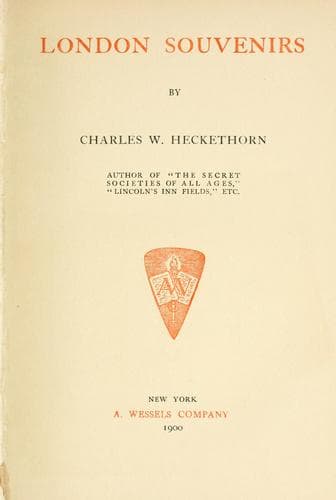
London (England) -- Description and travel; London (England) -- History -- 1800-1950
It was mentioned above that in the days of Sir Matthew Hale professional
etiquette allowed clients to have interviews with counsel without the
intervention of a solicitor. But gradually, after his time, the public
were deprived of this privilege, and a rigid rule was enforced that all
communications to counsel must be through the solicitor only, a rule
highly detrimental to litigants, since it caused constant
misunderstandings and misleading instructions. It is a roundabout way
of doing business, which would not be tolerated for a day in any
commercial transaction. It was from the first a tyrannical assumption
on the part of the profession that the public should submit to a
restriction, based nominally on professional etiquette, but really on
professional interest. The public have begun to object to the rule, and
in 1888 the Attorney-General (Sir R. Webster), on being asked to express
his views in reference to the occasions when a barrister may advise and
otherwise act for a client without the intervention of a solicitor,
replied that in contentious business, necessitating inquiry into facts,
which could not possibly be undertaken by a barrister, it was essential
that the latter should have the advice of a solicitor. But might this
advice not be given in the presence of the client to exclude the
possibility of misapprehension? As to non-contentious business Sir
Richard allowed of direct communication between counsel and client. My
own rule, whenever it has been my misfortune to be involved in a legal
dispute, has always been to push aside this bogie of professional
etiquette, and insist on telling counsel my own story myself.
Public-domain text, read in full here on John Shaqi.
Reviews
Reviews
No reviews yet
Be the first to share your thoughts on this work.
Elsewhere in the archive
Join the Discussion
Join the discussion
Sign in to leave a comment or review.
Sign InorCreate an account