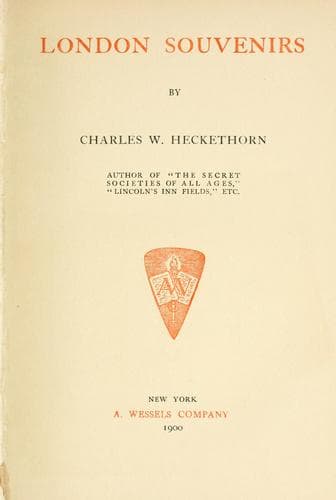
London (England) -- Description and travel; London (England) -- History -- 1800-1950
Wolsey cleverly exploited the situation; he first secured the goodwill
of Francis I. of France by restoring to him, in 1516, Tournay, receiving
in return an annuity of 12,000 livres. But the Pope was the most
anxious to secure the Minister’s friendship, and therefore, after the
recall of Cardinal Campeggio, made Wolsey his Legate a Latere, or
Extraordinary Envoy, which virtually raised him to the rank of Pope of
England. Though Wolsey’s income was already tremendous from the various
bishoprics and other high offices he held, and the presents and pensions
he received from foreign princes, the Pope granted him an annuity of
7,500 ducats on the bishoprics of Toledo and Placentia. With Wolsey’s
increase of power rose his arrogance, his covetousness, and his love of
ostentation; the beggar was put on horseback. His revenues almost
exceeded those of the Crown; the splendour displayed in his mode of
living was greater than that of many Kings. When, after the election of
Charles V. as Emperor of Germany, the latter quarrelled with Francis I.,
each endeavoured to draw the Cardinal to his side. In 1520 he arranged
an interview between the three Sovereigns, but at last sided with the
Emperor, who granted him an annuity of 7,000 ducats, and held out to him
the prospect of the Papal crown. After having, in 1521, attempted at
Calais a reconciliation between Henry VIII. and Francis I., he entered
into a secret treaty with the Emperor, according to which the English
King was to declare war against France. The death of Leo X. and the
subsequent election of Hadrian VI. to the Papal dignity almost led to a
breach between him and the Emperor; but the latter’s promise that after
old Hadrian’s death he would certainly procure him the Papal crown
satisfied Wolsey, especially as the Emperor added 2,500 ducats to the
former annuity, and gave him besides another of 9,000 dollars in gold
for his loss of the French pension. In 1522 Henry VIII. commenced the
war against his former ally by entering and devastating France. Wolsey
having to find money for this war, he had recourse to financial
oppression, which roused the indignation of the English people. But at
the new Papal election in 1523 Wolsey saw himself again passed over,
which induced him to lead the King to take the part of Francis I., who
was then a prisoner. Henry VIII. had to retire from the war, to enter in
1525 into an alliance with the French Regency, for which service Wolsey
received a present of 100,000 crowns, and in 1528 to declare war against
the Emperor. Thus the proud and blustering Henry VIII. became the mere
tool of an ambitious and disappointed priest, who used him and the
resources of England to avenge the slight the Emperor had put upon him
at the last Papal election. After the peace of Cambray in 1529, Wolsey
was on the summit of his power, but also terribly near to his fall. At
first he had, from hatred of her nephew, Charles V., not opposed the
Public-domain text, read in full here on John Shaqi.
Reviews
Reviews
No reviews yet
Be the first to share your thoughts on this work.
Elsewhere in the archive
Join the Discussion
Join the discussion
Sign in to leave a comment or review.
Sign InorCreate an account