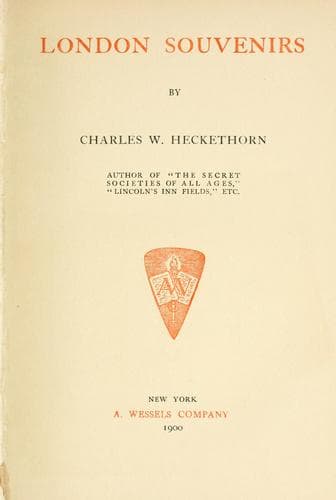
London (England) -- Description and travel; London (England) -- History -- 1800-1950
King’s desire to obtain a divorce from Catherine of Aragon; but when he
found that the King wanted to marry Anne Boleyn, he disapproved of the
divorce, as he feared that Anne’s relatives might endanger his position
at Court. In obedience to the King’s orders, he indeed for some time
urged on the suit, but grew less zealous when he found that the Pope
himself, out of consideration for the Emperor, was against the divorce.
Henry VIII. looked upon the delay as due to the intrigues of Wolsey, in
which opinion he was strengthened by Anne Boleyn, who had a special
reason to hate him, for it was through him that her marriage with young
Lord Percy, a member of Wolsey’s establishment, one of the many scions
of the nobility who were placed under the guidance of the Cardinal, had
been broken off. When Anne, who had been dismissed the Court, after her
recall found it necessary to augment her rising influence over the King
to dissemble, and therefore treated Wolsey with the greatest outward
respect, she secretly took every opportunity to foster the dislike Henry
had taken to him, and it was her underhand influence which hastened his
downfall, and not reasons of statecraft, as ’philosophical’ historians
would have us believe. Long before the catastrophe Wolsey, who had not
failed to notice that the brutal tyrant’s favourable sentiments towards
his minion were on the wane, had tried to conciliate the King by
presenting Hampton Court to him in 1526; but the gift had not been one
of love, but of fear and despair, and the chief cause of the surrender,
according to tradition, was the following:
The King’s fool was paying a visit to the Cardinal’s fool—for both the
King and the Cardinal were such fools themselves as to find pleasure in
the gabbling of professional fools—and the couple went down into the
wine vaults. For fun one of them stuck a dagger into the top of a cask,
and, to his surprise, touched something that gave a metallic sound. The
fools thereupon set to work, got the head of the cask out, and found it
to be full of gold pieces. Other casks, by the sound, indicated that
they held wine. The King’s fool stored up the fact in his memory, and
one day when the King was boasting about his wine, the fool said, ’You
have not such wine as my Lord Cardinal, for he has casks in his cellar
worth a thousand broad pieces each;’ and then he told what he had
discovered. Whether this be true or not, it is certain that Wolsey was
awake to the fact that he was losing his power over the King, and so he
threw him the magnificent sop of his palace, which, however, did not
save him; the King was determined to be rid of him. In October, 1529,
the Great Seal was demanded of him, his palace at Whitehall and all his
goods were seized for the King’s use, and he was ordered to retire to
his palace at Esher. The King, indeed, promised Wolsey his protection,
and that he should continue to hold the bishoprics of York and
Winchester.
Public-domain text, read in full here on John Shaqi.
Reviews
Reviews
No reviews yet
Be the first to share your thoughts on this work.
Elsewhere in the archive
Join the Discussion
Join the discussion
Sign in to leave a comment or review.
Sign InorCreate an account