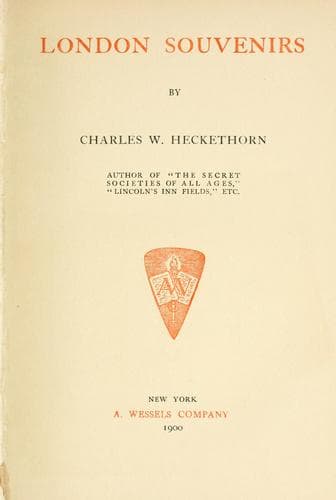
London (England) -- Description and travel; London (England) -- History -- 1800-1950
As Wolsey was travelling towards Esher, he was overtaken by a messenger
from the King, who brought him that comfortable assurance, whereupon the
Cardinal dismounted from his mule, knelt down, and blessed the ground on
which he had received so gracious a message; and to show his gratitude
to his King, he made him a present of—what do you think?—his fool. Had
Wolsey in his disgrace shown any manliness or dignity of character, we
might think that this present to the King was ’kinder sarcastic,’
intimating that a fool was about the only individual fit to be Henry’s
companion, and whom he could appreciate. But from Wolsey’s conduct
during the closing years of his life, we cannot give him credit for so
much wit and moral courage as the attempt to give the King such a hint
would have implied, and we must therefore assume that the gift was a
_bonâ fide_ one; and as in those days it was considered the proper thing
for great people to associate with fools, and take delight in their
forced and artificial jokes, too poor for a halfpenny comic paper of the
present day, there was nothing extraordinary in the gift, and no doubt
the King thought it highly complimentary to himself. But however
favourably the King might at certain moments feel disposed towards
Wolsey, and though, from his influence in the country as head of the
Church, it was necessary to go to work cautiously, his ruin was
determined on. Parliament, which, after an interval of seven years, was
allowed to reassemble in 1529, impeached him by a charge of forty-four
articles, relating chiefly to the exercise of his legatine power
contrary to law, and the scandalous irregularities of his life. The
impeachment passed the House of Lords; but when it came to the House of
Commons it was effectually defeated by the energy and address of Thomas
Cromwell, who had been his servant, so that no treason could be fixed
upon him. He remained in his retirement at Esher until about Easter,
1530, when he was ordered to repair to his diocese of York, where, in
November of the same year, he was arrested by the Earl of Northumberland
for high treason, and committed to the custody of the Lieutenant of the
Tower, who had orders to bring him to London. This so affected his mind
that he fell sick at Sheffield, in the Earl of Shrewsbury’s house,
whence, by short stages, he went as far as Leicester, where he is said
to have taken poison, which no one knowing his really pusillanimous
character will believe; however, he died on November 29, 1530, and was
buried in the Abbey of Leicester. The words attributed to him as his
last utterances, that if he had served God as he had served his King, he
would not be thus forsaken, were false in substance and contemptible in
form. He never served the King but when it served his own purposes, and
a mean-spirited coward only would have attributed his fall to such a
cause. He fell most ignominiously, without even an attempt of
Public-domain text, read in full here on John Shaqi.
Reviews
Reviews
No reviews yet
Be the first to share your thoughts on this work.
Elsewhere in the archive
Join the Discussion
Join the discussion
Sign in to leave a comment or review.
Sign InorCreate an account