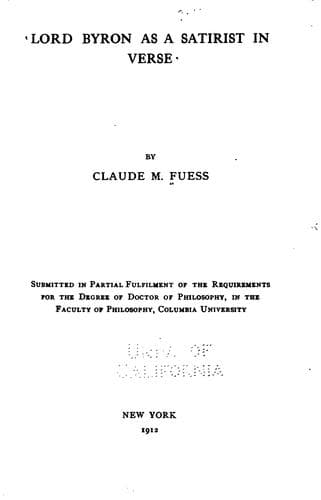
Lord Byron as a satirist in verseFuess, Claude Moore
History
Lord Byron as a satirist in verse
Fuess, Claude Moore
Byron, George Gordon Byron, Baron, 1788-1824 -- Criticism and interpretation; Verse satire, English -- History and criticism
“I thought, at setting off, about two dozen
Cantos would do; but at Apollo’s pleading,
If that my Pegasus should not be foundered,
I hope to canter gently through a hundred.”[282]
As it lengthened _Don Juan_ developed more and more into a verse diary,
bound, from the looseness of its design, to remain uncompleted at
Byron’s death.
But whatever may have actuated Byron in beginning _Don Juan_ and
however uncertain he may have been at first about its ultimate purpose,
it soon grew to be primarily satirical. He himself perceived this
in describing it to Murray in 1818 as “meant to be a little quietly
facetious upon everything”[283] and in characterizing it in 1822 as
“a _Satire_ on _abuses_ of the present states of society.”[284]
Despite the intermingling of other elements, the poem is exactly what
Byron called it--an “Epic Satire.”[285] His remark “I was born for
opposition” indicates how much at variance with his age he felt himself
to be; and his inclination to pick flaws in existing institutions
and to indulge in destructive criticism of his time had become so
strong that any poem which expressed fully his attitude towards life
was bound to be satirical. Just as the cosmopolitan outlook of the
poem is due partly to Byron’s long-continued residence in a foreign
country, so its varied moods, its diverse methods, and its wide range
of subject matter are to be attributed, to a large extent, to the fact
that the composition of _Don Juan_ extended over several years during
a period when he was growing intellectually and responding eagerly to
new ideas.[286] The work is a fair representation of Byron’s theories
and beliefs during the period of his maturity, when he was developing
into an enlightened advocate of progressive and liberal doctrines.
It is an attack on political inertia and retrogression, on social
conventionality, on cant and sham and intolerance. The intermittent,
erratic, and somewhat imitative radicalism of a few of his earlier
poems has changed into a persistent hostility to all the reactionary
conservation of the time. _Don Juan_ is satiric, then, in that it is
a protest against all that hampers individual freedom and retards
national independence.
The pervasive satiric spirit of _Don Juan_ has varied manifestations.
In a few passages there are examples of rancor and spite, of direct
personal denunciation and furious invective, that recall the satire of
_English Bards_. The attacks on Castlereagh and Southey, on Brougham
and Lady Byron are in deadly earnest, with hardly a touch of mockery.
At the same time Byron relies mainly on the more playful and less
savage method which he had learned from the Italians and used in
_Beppo_. He himself expressed this alteration in mood by saying,
“Methinks the older that one grows,
Inclines us more to laugh than scold.”[287]
Public-domain text, read in full here on John Shaqi.
Reviews
Reviews
No reviews yet
Be the first to share your thoughts on this work.
Elsewhere in the archive
Join the Discussion
Join the discussion
Sign in to leave a comment or review.
Sign InorCreate an account