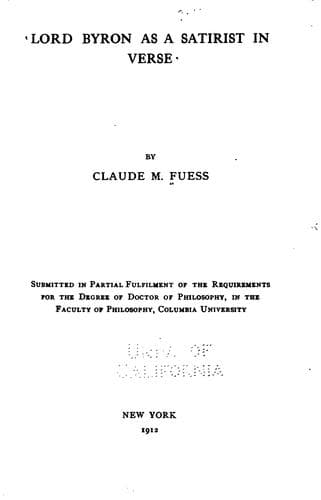
Lord Byron as a satirist in verseFuess, Claude Moore
History
Lord Byron as a satirist in verse
Fuess, Claude Moore
Byron, George Gordon Byron, Baron, 1788-1824 -- Criticism and interpretation; Verse satire, English -- History and criticism
It is noticeable, too, that in _Don Juan_ petulant fury is much less
conspicuous than philosophic satire. Byron is assailing institutions
and theories as well as men and women. To some extent the poem is a
medium for satisfying a quarrel or a prejudice; but to a far greater
degree it is a summary of testimony hostile to the reactionary early
nineteenth century. The poet still prefers, in many cases, to make
specific persons responsible for intolerable systems; but he is
gradually forsaking petty aims and rising to a far nobler position as a
critic of his age.
The satire in _Don Juan_ is still more remarkable when we consider
the field which it surveys. Byron is no longer dealing with local
topics, but with subjects of momentous interest to all humanity. He
is assailing, not a small coterie of editors or an immodest dance,
but a bigoted and absolute government, a hypocritical society, and, a
false idealism, wherever they exist. More than this, he so succeeds
in uniting his satire, through the force of his personality, with the
eternal elements of realism and romance, that the combination, complex
and intricate though it is, seems to represent an undivided purpose.
Perhaps the loftiest note in Byron’s protest is struck in dealing
with the political situation of his day. Despite his noble birth and
his aristocratic tastes, he had become, partly through temperamental
inclination, partly through association with Moore and Hunt, a fairly
consistent republican, though he took care to make it clear, as Nichol
points out, that he was “for the people, not of them.” Impatient of
restraint on his own actions, he extended his belief in personal
liberty until it included the advocacy of any democratic movement. It
is to his credit, moreover, that he was no mere closet theorist; in
Italy he espoused the cause of freedom in a practical way by abetting
and joining the revolutionary _Carbonari_; and he died enrolled in the
ranks of the liberators of Greece. In _Don Juan_ he declares himself
resolutely opposed to tyranny in any form, asserting his hatred of
despotism in memorable lines:
“I will teach, if possible, the stones
To rise against earth’s tyrants. Never let it
Be said that we still truckle unto thrones.”[288]
Such doctrine was, of course, not new in Byron’s poetry. He had
already spoken eloquently and mournfully of the loss of Greek
independence[289]; he had prophesied the downfall of monarchs and the
triumph of democracy[290]; and he had inserted in _Childe Harold_ that
vigorous apostrophe to liberty:
“Yet, Freedom, yet thy banner, torn but flying,
Streams like the thunder-storm against the wind.”[291]
In _Don Juan_, however, Byron is less rhetorical and more direct. In
expressing his
“Plain sworn downright detestation
Of every despotism in every nation,”[292]
he does not hesitate to condemn all absolute monarchs; moreover he
displays a sincere faith in the ultimate success of popular government:
Public-domain text, read in full here on John Shaqi.
Reviews
Reviews
No reviews yet
Be the first to share your thoughts on this work.
Elsewhere in the archive
Join the Discussion
Join the discussion
Sign in to leave a comment or review.
Sign InorCreate an account