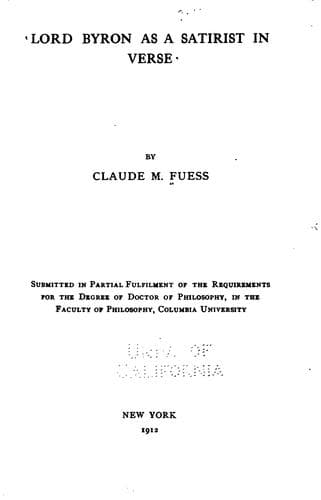
Lord Byron as a satirist in verseFuess, Claude Moore
History
Lord Byron as a satirist in verse
Fuess, Claude Moore
Byron, George Gordon Byron, Baron, 1788-1824 -- Criticism and interpretation; Verse satire, English -- History and criticism
Since _The Vision of Judgment_ was Byron’s only attempt at genuine
travesty, it may be well to differentiate between the travesty and
other kindred forms of satire, all of which are commonly grouped under
the generic heading, burlesque. Broadly speaking, a burlesque is any
literary production in which there is an absurd incongruity in the
adjustment of style to subject matter or subject matter to style,
humor being excited by a continual contrast between what is high and
what is low, what is exalted and what is commonplace.[358] The peculiar
effect of burlesque is ordinarily dependent upon its comparison with
some form of literature of a more serious nature. Of the subdivisions
of burlesque, the parody aims particularly at the humorous imitation
of the style and manner of another work, the original characters and
incidents being displaced by incidents of a more trifling sort. The
parody has been a popular variety of satire, and examples of it may
be discovered in the productions of any sophisticated or critical
age.[359] The travesty, in the narrow sense of the term, is a humorous
imitation of another work, the subject matter remaining substantially
the same, being made ridiculous, however, by a grotesque treatment and
a less imaginative style. A serious theme is thus deliberately degraded
and debased. The commonest subjects of travesty have been derived, as
one might expect, from mythology or from the great epic poems. Its
popularity, except in certain limited periods, has never equalled that
of the parody.[360]
Considered simply as a travesty, Byron’s _Vision_ is remarkable
in two respects: first, in that it burlesques a contemporary poem,
while most other travesties ridicule works of antiquity, or at least
of established repute; second, in that it has an intrinsic merit of
its own far surpassing that of the poem which suggested it. Thus the
general dictum that a travesty is valuable chiefly through the contrast
which it presents to some nobler masterpiece is contradicted by Byron’s
satire, which is in itself an artistic triumph.
Public-domain text, read in full here on John Shaqi.
Reviews
Reviews
No reviews yet
Be the first to share your thoughts on this work.
Elsewhere in the archive
Join the Discussion
Join the discussion
Sign in to leave a comment or review.
Sign InorCreate an account