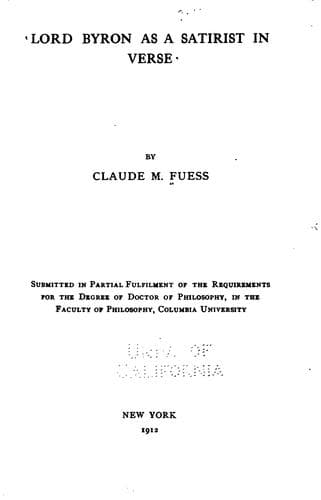
Lord Byron as a satirist in verseFuess, Claude Moore
History
Lord Byron as a satirist in verse
Fuess, Claude Moore
Byron, George Gordon Byron, Baron, 1788-1824 -- Criticism and interpretation; Verse satire, English -- History and criticism
Within this limited space it has been possible to touch only upon one
or two phases of the many which this poem, perhaps the greatest in
English since _Paradise Lost_, presents to the reader. Byron’s satire,
in assuming a wider scope and a greater breadth of view, in growing
out of the insular into the cosmopolitan, has also blended itself with
romance and realism, with the lyric, the descriptive, and the epic
types of poetry until it has created a new literary form and method
suitable only to a great genius. His satiric spirit, in assailing not
only individuals, but also institutions, systems, and theories of life,
in concerning itself less with literary grudges and personal quarrels
than with momentous questions of society, in progressing steadily from
the specific to the universal, has undergone a striking evolution.
The tone of his satire has become less formal and dignified, and more
colloquial, while a more frequent use of irony, burlesque, and verbal
wit makes the poem easier and more varied. Byron joins mockery with
invective, raillery with contempt, so that _Don Juan_, in retaining
certain qualities of the old Popean satire, seems to have tempered
and qualified the acrimony of _English Bards_. The inevitable result
of this development was to make _Don Juan_ a reflection of Byron’s
personality such as no other of his works had been. _Don Juan_ is
Byron; and in this fact lies the explanation of its strength and
weakness.
CHAPTER IX
“THE VISION OF JUDGMENT”
Byron’s _Vision of Judgment_, printed in the first number of _The
Liberal_, October 15, 1820, was the climax of his long quarrel with
Southey, the complicated details of which have been related at length
by Mr. Prothero in his edition of the _Letters and Journals_.[357]
Byron’s hostility to Southey was due apparently to several causes,
some personal, some political, and some literary. He believed that
Southey had spread malicious reports about the alleged immorality of
his life in Switzerland with Jane Clermont, Mary Godwin, and Shelley;
he considered the laureate to be an apostate from liberalism and a
truckler to aristocracy; and he had no patience with his views on
poetry and his lack of respect for Pope. The two men were, in fact,
fundamentally incompatible in temperament and opinions, Southey being
firmly convinced that Byron was a dissipated and dangerous debauchee,
while Byron thought Southey a dull, servile, and somewhat hypocritical
scribbler.
Public-domain text, read in full here on John Shaqi.
Reviews
Reviews
No reviews yet
Be the first to share your thoughts on this work.
Elsewhere in the archive
Join the Discussion
Join the discussion
Sign in to leave a comment or review.
Sign InorCreate an account