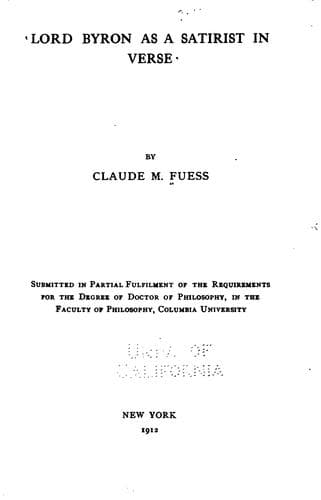
Lord Byron as a satirist in verseFuess, Claude Moore
History
Lord Byron as a satirist in verse
Fuess, Claude Moore
Byron, George Gordon Byron, Baron, 1788-1824 -- Criticism and interpretation; Verse satire, English -- History and criticism
Byron had begun his travesty on May 7, 1821, and had sent it to Murray
from Ravenna on October 4th.[363] Unconscious of the fact that this
satire was in Murray’s hands, Southey meanwhile had published his
_Letter to the Courier_, January 5, 1822, vindictively personal, and
containing one unlucky paragraph: “One word of advice to Lord Byron
before I conclude. When he attacks me again, let it be in rhyme. For
one who has so little command of himself, it will be a great advantage
that his temper should be obliged to keep tune.” When this _Letter_
came to Byron’s notice, his anger boiled over; he sent Southey a
challenge, which through the discretion of Kinnaird, was never
delivered[364]; and he decided immediately to publish his _Vision_,
which he had almost determined to suppress. Murray, however, delayed
the proof, and on July 3, 1822, Byron, irritated by this tardiness and
enthusiastic over his newly planned periodical, _The Liberal_, sent a
letter by John Hunt,[365] the proprietor of the magazine, requesting
Murray to turn the satire over to Hunt. In the first number of _The
Liberal_, then, the _Vision_ was given the most conspicuous position,
printed, however, without the preface, which Murray, either ignorantly
or unfairly, had withheld from Hunt. A vigorous letter from Byron
recovered the preface, which was inserted in a second edition of the
periodical.[366] The consequences of publication somewhat justified
Murray’s apprehensions. John Hunt was prosecuted by the Constitutional
Association, and on July 19, 1824, only three days after Byron’s body
had been buried in the church of Hucknall Torkard, was convicted,
fined one hundred pounds, and compelled to enter into securities
for five years. In fairness to Byron, it must be added that he had
offered to come to England in order to stand trial in Hunt’s stead,
and had desisted only when he found that such procedure would not be
allowed.[367]
In his _Vision_, Byron had at least four objects for his satire. He
wished to ridicule Southey’s poem by burlesquing many of its absurd
elements; he aimed to proceed more directly against Southey by exposing
the weak points in his character and career; he desired to present
a true picture of George III, in contrast to Southey’s idealized
portrait; and he intended to make a general indictment of all illiberal
government and particularly of the policy then being pursued by the
English Tory party. He seized instinctively upon the weaknesses of the
panegyric, and while preserving the general plan and retaining many of
the characters, freely mocked at its cant and smug conceit. Through a
style purposely grotesque and colloquial, he turned Southey’s pompous
rhetoric into absurdity; by touches of realism and caricature he made
the solemn angels and demons laughable; while, occasionally rising to a
loftier tone suggestive of the spirit of _Don Juan_, he reasserted his
love of liberty and hatred of despotism.
Public-domain text, read in full here on John Shaqi.
Reviews
Reviews
No reviews yet
Be the first to share your thoughts on this work.
Elsewhere in the archive
Join the Discussion
Join the discussion
Sign in to leave a comment or review.
Sign InorCreate an account