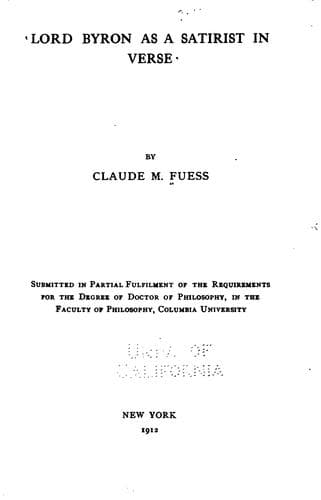
Lord Byron as a satirist in verseFuess, Claude Moore
History
Lord Byron as a satirist in verse
Fuess, Claude Moore
Byron, George Gordon Byron, Baron, 1788-1824 -- Criticism and interpretation; Verse satire, English -- History and criticism
In executing his project, Byron deliberately neglected a large part
of Southey’s _Vision_ and confined himself almost exclusively to
the scene at the trial of the King. He began actually with the
situation represented in Section IV of Southey’s poem, omitting all
the preliminary matter, and ended with Southey’s Section V, avoiding
entirely the meeting of George with the English worthies. So far as
subject matter is concerned, Byron travestied only two of the twelve
divisions of the earlier work. He concentrated his attention on the
judgment of the King, and then deserted formal travesty in order to
introduce his attack on Southey.
It was part of Byron’s scheme that angels and demons, serious
characters in Southey’s poem, should be made the objects of mirth. By
a dexterous application of realism, he changed the New Jerusalem of
Southey into a very earthly place, where angels now and then sing out
of tune and hoarse, and where six angels and twelve saints act as a
business-like Board of Clerks. These creatures of the spiritual realm
are very substantial beings, not at all immune from mortal infirmities
and passions. Saint Peter is a dull somnolent personage who grumbles
over the leniency of heaven’s Master towards earth’s kings, and sweats
through his apostolic skin at the appalling sight of Lucifer and demons
pursuing the body of George to the very doors of heaven. Satan salutes
Michael,
“as might an old Castilian
Poor noble meet a mushroom rich civilian,”
and the archangel, in turn, greets the fallen Lucifer superciliously as
“my good old friend.” It is probable that in this practice of treating
with ridicule those beings who are commonly spoken of with reverence,
Byron is imitating Pulci, whose angels and devils are also, in their
attributes, more human than divine.
Byron’s trial scene, in which Lucifer and Michael dispute for the
possession of George III, is an admirable travesty of Southey’s
representation of the same episode. The glorified monarch of Southey’s
_Vision_ meets in Byron’s satire with scant courtesy from Lucifer, who
acts as attorney for the prosecution. Lucifer admits the king’s “tame
virtues” and grants that he was a “tool from first to last”; but he
charges him with having “ever warr’d with Freedom and the free,” with
having stained his career with “national and individual woes,” with
having resisted Catholic emancipation, and with having lost a continent
to his country. Wilkes and Junius, the two shamefaced accusers of
Southey’s _Vision_, now act in a different manner. Wilkes scornfully
extends his forgiveness to the king, and Junius, while reiterating
the truth of his original accusations, refuses to be enlisted as
an incriminating witness. This section of the satire is splendidly
managed. The whole assault on the king tends to show him as more
misguided than criminal. The lines,
“A better farmer ne’er brush’d dew from lawn,
A worse king never left a realm undone!”
Public-domain text, read in full here on John Shaqi.
Reviews
Reviews
No reviews yet
Be the first to share your thoughts on this work.
Elsewhere in the archive
Join the Discussion
Join the discussion
Sign in to leave a comment or review.
Sign InorCreate an account