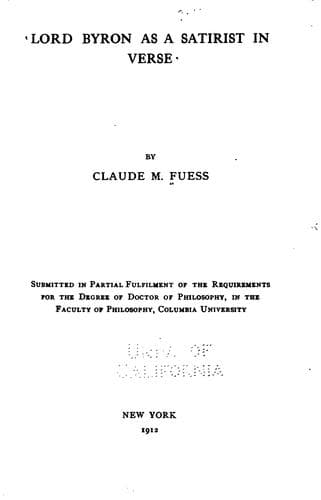
Lord Byron as a satirist in verseFuess, Claude Moore
History
Lord Byron as a satirist in verse
Fuess, Claude Moore
Byron, George Gordon Byron, Baron, 1788-1824 -- Criticism and interpretation; Verse satire, English -- History and criticism
_The Vision of Judgment_ is, if we exclude _Don Juan_ as being more
than satire, the greatest verse-satire that Byron ever wrote. It is
only natural then to compare the poem with other English satires
which have high rank in our literature. A practically unanimous
critical decision has established Dryden’s _Absalom and Achitophel_ as
occupying the foremost position in English satire before the time of
Byron. Unquestionably this work of Dryden’s is admirable; it is witty,
pointed, and direct, embellished with masterly character sketches and
almost faultless in style. It does, however, suffer somewhat from a
lack of unity, due primarily to the fact that the narrative element
in the poem is subordinate to the description. Byron’s _Vision_, on
the other hand, has a single plot, which is carefully carried out to a
climax and a conclusion. Action joins with invective and description
in forming the satire. Thus the two poems, approximately the same
length if we consider only Part I of _Absalom and Achitophel_, give a
decidedly different impression. Dryden’s satire seems a panorama of
figures, while Byron’s has the coherence and clash of a drama.
_Absalom and Achitophel_ is witty but seldom humorous; while Byron
joins caricature and burlesque to wit. The best lines in Dryden’s poem,
such as:
“Beggar’d by fools, whom still he found too late;
He had his jest, and they had his estate,”
excite admiration for the author’s cleverness, but rarely arouse a
smile; the _Vision_, the contrary, is full of buffoonery. Dryden’s
sense of the dignity of the satirist’s office did not permit him to
lower his style, and he never became familiar with his readers; the
very essence of Byron’s satire is its colloquial character.
Dryden kept his personality always in the background, while the
egotistical Byron could not refrain from letting his individuality
lend fire and passion to whatever he wrote. Thus the _Vision_, despite
the fact that it is the most cool of Byron’s satires, cannot be called
calm and restrained. Self-control, the will to subdue and govern his
impulses and prejudices, was beyond his reach. Fortunately in the
_Vision_ he did take time to exercise craftsmanship, but he never
attained the polished artistry and firm reserve of his predecessor.
Certainly in urbanity, in dignity, and in justice Dryden is the
superior, just as he is undoubtedly less imaginative, less varied, and
less spirited than Byron.
The two satires are, then, radically different in their methods. One
is a masterpiece of the Latin classical satire in English, formal and
regular, and using the standard English couplet; the other is our
finest example of the Italian style in satire--the mocking, grotesque,
colloquial, and humorous manner of Pulci and Casti. Both are effective;
but one is inclined to surmise that the purple patches in _Absalom
and Achitophel_ will outlast the more perfect whole of _The Vision of
Judgment_.
Public-domain text, read in full here on John Shaqi.
Reviews
Reviews
No reviews yet
Be the first to share your thoughts on this work.
Elsewhere in the archive
Join the Discussion
Join the discussion
Sign in to leave a comment or review.
Sign InorCreate an account