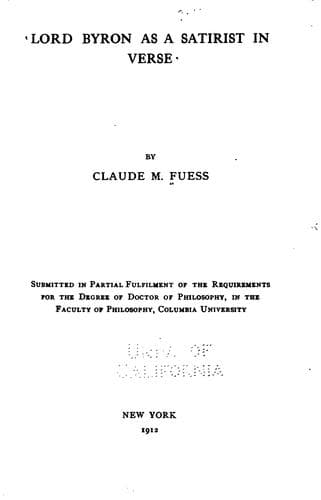
Lord Byron as a satirist in verseFuess, Claude Moore
History
Lord Byron as a satirist in verse
Fuess, Claude Moore
Byron, George Gordon Byron, Baron, 1788-1824 -- Criticism and interpretation; Verse satire, English -- History and criticism
The probable results of the publication of a work of such a sensational
character had been foreseen by both Murray and Longman. When the first
number of _The Liberal_ appeared containing not only _The Vision
of Judgment_ but also three epigrams of Byron’s on the death of
Castlereagh, it was received by a torrent of hostile criticism from
the Tory press. The _Literary Gazette_ for October 19, 1822, called
Byron’s work “heartless and beastly ribaldry,” and added on November
2, that Byron had contributed to the _Liberal_ “impiety, vulgarity,
inhumanity, and heartlessness.” The _Courier_ for October 26 termed him
“an unsexed Circe, who gems the poisoned cup he offers us.” On the
Whig side, in contrast, Hunt’s _Examiner_ for September 29 spoke of it
as “a Satire upon the Laureate, which contains also a true and fearless
character of a grossly adulated monarch.”
Byron himself described it to Murray as “one of my best things.”[376]
Later critical opinion has also tended to rank it very high. Goethe
called the verses on George III “the sublime of hatred.” Swinburne,
himself a revolutionist but no partisan of Byron’s, exhausts
superlatives in commenting on it: “This poem--stands alone, not in
Byron’s work only, but in the work of the world. Satire in earlier
times had changed her rags for robes; Juvenal had clothed with fire,
and Dryden with majesty, that wandering and bastard muse. Byron gave
her wings to fly with, above the reach even of these. Others have
had as much of passion and as much of humor; Dryden had perhaps as
much of both combined. But here, and not elsewhere, a third quality
is apparent--the sense of a high and clear imagination.--Above all,
the balance of thought and passion is admirable; human indignation
and divine irony are alike understood and expressed; the pure and
fiery anger of men at the sight of wrong-doing, the tacit inscrutable
derision of heaven.” Nichol, in his life of Byron, says:--“Nowhere in
so much space, save in some of the prose of Swift, is there in English
so much scathing satire.”
Two figures in Byron’s poem have been made the basis of a shrewd
comparison by Henley. He says: “Byron and Wordsworth are like the
Lucifer and Michael of _The Vision of Judgment_. Byron’s was the
genius of revolt, as Wordsworth’s was the genius of dignified and
useful submission; Byron preached the doctrine of private revolution,
Wordsworth the dogma of private apotheosis--Byron was the passionate
and dauntless ‘soldier of a forlorn hope,’ Wordsworth a kind of
inspired clergyman.” Byron’s sympathies in the _Vision_, as in _Cain_,
were undoubtedly with Lucifer, the rebel and exile, and his poem will
live as a satiric declaration of the duty of active resistance to
despotism and oppression.
CHAPTER X
“THE AGE OF BRONZE” AND “THE BLUES”
Public-domain text, read in full here on John Shaqi.
Reviews
Reviews
No reviews yet
Be the first to share your thoughts on this work.
Elsewhere in the archive
Join the Discussion
Join the discussion
Sign in to leave a comment or review.
Sign InorCreate an account