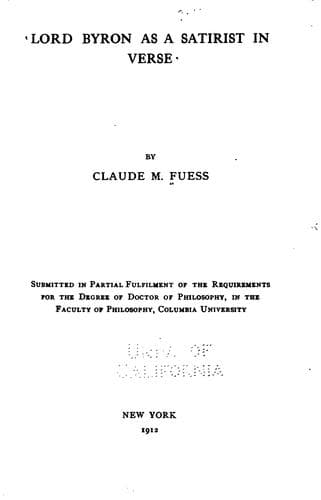
Lord Byron as a satirist in verseFuess, Claude Moore
History
Lord Byron as a satirist in verse
Fuess, Claude Moore
Byron, George Gordon Byron, Baron, 1788-1824 -- Criticism and interpretation; Verse satire, English -- History and criticism
Byron’s _Monody on the Death of Sheridan_, written at Diodati on
July 17, 1816, and recited in Drury Lane Theatre on September 7, was
followed by a period of several years in which he ceased to employ the
heroic couplet in poetry of any sort. The reasons for this temporary
abandonment of what had been, hitherto, a favorite measure, are not
altogether clear, although his action may be ascribed, in part, to his
renunciation of things English and to the influence upon him of his
study of the Italians. During his residence in Italy, Byron used many
metrical forms: the Spenserian stanza, ottava rima, terza rima, blank
verse, and other measures in some shorter lyrics and ephemeral verses.
Not until _The Age of Bronze_, which he began in December, 1822, did he
return to the heroic couplet of _English Bards_.
On January 10, 1823, Byron, then living in Genoa, wrote a letter to
Leigh Hunt, in which, among other things, he said: “I have sent to
Mrs. S[helley], for the benefit of being copied, a poem of about
seven hundred and fifty lines length--_The Age of Bronze_--or _Carmen
Seculare et Annus haud Mirabilis_, with this Epigraph--‘Impar
_Congressus_ Achilli’.” By way of description, he added: “It is
calculated for the reading part of the million, being all on politics,
etc., etc., etc., and a review of the day in general,--in my early
_English Bards_ style, but a little more stilted, and somewhat too full
of ‘epithets of war’ and classical and historical allusions.”[377]
The work as revised and completed contains 18 sections and 778 lines.
Originally destined for _The Liberal_, it was eventually published
anonymously by John Hunt, on April 1, 1823.
_The Age of Bronze_ is, then, entirely a political satire, intended
chiefly as a counterblast to the recent stringent regulations of the
reactionary Congress of Verona (1822). It comprises, however, other
material: an introductory passage on the great departed leaders, Pitt,
Fox, and Bonaparte; frequent digressions treating of the struggles
for constitutional government then taking place in Europe; and some
lines attacking the landed proprietors in England for their luke-warm
opposition to foreign war. It is, in nearly every sense, a timely poem,
although the note of “Vanitas Vanitatum” sounded in the early sections
gives the satire a universal application.
Public-domain text, read in full here on John Shaqi.
Reviews
Reviews
No reviews yet
Be the first to share your thoughts on this work.
Elsewhere in the archive
Join the Discussion
Join the discussion
Sign in to leave a comment or review.
Sign InorCreate an account