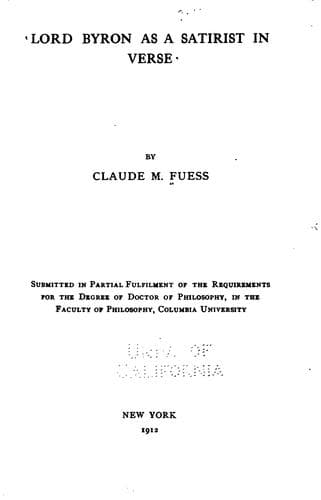
Lord Byron as a satirist in verseFuess, Claude Moore
History
Lord Byron as a satirist in verse
Fuess, Claude Moore
Byron, George Gordon Byron, Baron, 1788-1824 -- Criticism and interpretation; Verse satire, English -- History and criticism
The reference to these giants of the past leads Byron naturally to a
glorification of such liberators as Kosciusko, Washington, and Bolivar,
and to a joyful heralding of revolutions in Chili, Spain, and Greece:
“One common cause makes myriads of one breast,
Slaves of the east, or helots of the west;
On Andes’ and on Athos’ peaks unfurl’d,
The self-same standard streams o’er either world.”
Under the influence of this enthusiasm he prophecies a liberal outburst
which will end in the regeneration of Europe.
Contrasted with the optimism of this aspiring idealism is Byron’s gloom
over the deeds of the Congress of Verona. The measures advocated by
this gathering, as we have seen, were reactionary and autocratic; and
Byron’s description of it, tinged with liberal sentiment, is vigorously
satirical. In the conference headed by Metternich, “Power’s foremost
parasite,” he can see nothing but a body of tyrants,
“With ponderous malice swaying to and fro,
And crushing nations with a stupid blow.”
Many of the allusions in Byron’s sketches of the members recall the
language used by Moore in his _Fables for the Holy Alliance_. Moore’s
views of the situation in Europe agreed substantially with those of
Byron. Byron’s reference to the “coxcomb czar,”
“The autocrat of waltzes and of war,”
recalls Moore’s mention of that sovereign in _Fable I_:
“So, on he capered, fearless quite,
Thinking himself extremely clever,
And waltzed away with all his might,
As if the Frost would last forever.”
Byron accuses Louis XVIII, who was not present at the Congress, of
being a gourmand and a hedonist,
“A mild Epicurean, form’d at best
To be a kind host and as good a guest.”
The same idea is conveyed in Moore’s description of that king as,
“Sighing out a faint adieu
To truffles, salmis, toasted cheese.”
Especially painful to Byron was the report that Marie Louise
(1791–1849), Napoleon’s widow, who had been secretly married to her
chamberlain, Adam de Neipperg, had attended the Congress, and had
become reconciled to her first husband’s captors. One section of the
satire paints a picture of her leaning on the arm of the Duke of
Wellington, “yet red from Waterloo,” before her husband’s ashes have
had time to chill.
The most bitter, and, at the same time, the most just satire in the
poem is directed at the English landed gentry:
“The last to bid the cry of warfare cease,
The first to make a malady of peace.”
The rise in prices due to the long-continued war had fattened the
purses of the farmers and land-holders in England, and led them to wish
secretly for the continuance of the struggle. Byron attacks severely
their grudging assent to proposals of peace, and, in a succession
of rhymes on the word “rent,” points out the selfishness of their
position. The diatribe contains some of Byron’s most passionate lines:
Public-domain text, read in full here on John Shaqi.
Reviews
Reviews
No reviews yet
Be the first to share your thoughts on this work.
Elsewhere in the archive
Join the Discussion
Join the discussion
Sign in to leave a comment or review.
Sign InorCreate an account