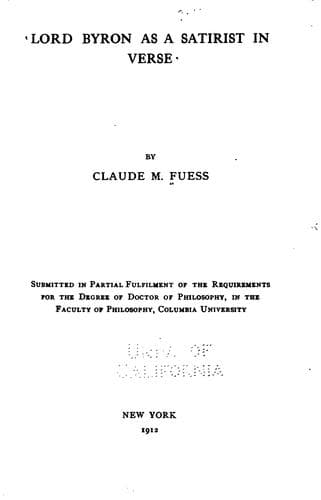
Lord Byron as a satirist in verseFuess, Claude Moore
History
Lord Byron as a satirist in verse
Fuess, Claude Moore
Byron, George Gordon Byron, Baron, 1788-1824 -- Criticism and interpretation; Verse satire, English -- History and criticism
“See these inglorious Cincinnati swarm,
Farmers of war, dictators of the farm;
_Their_ ploughshare was the sword in hireling hands,
_Their_ fields manured by gore of other lands;
Safe in their barns, these Sabine tillers sent
Their brethren out to battle--why? for rent!”
Although an occasional touch of mockery reminds us of _Don Juan, The
Age of Bronze_, in method, shows a reversion to the invective manner of
_English Bards_. It can hardly be said, however, that this later satire
is any advance over the earlier poem. Its allusions are now unfamiliar
to the average reader, and the names once so pregnant with meaning have
faded into dim memories. Although _The Age of Bronze_ has sagacity and
practicality, it lacks unity and concentration. Without the vehement
sweep of _English Bards_, it is also too rhetorical and declamatory.
Most readers, despite the flash of spirit which now and then lights its
pages, have found the satire dull.
_The Blues_, so little deserving of attention in most respects, is
unique among Byron’s satires for two reasons: it is written in the form
of a play, and it employs the anapestic couplet metre, used by Anstey
and later by Moore. Byron’s first reference to it occurs in a letter
to Murray from Ravenna, August 7, 1821: “I send you a thing which I
scratched off lately, a mere buffoonery, to quiz _the Blues_, in two
literary eclogues. If published, it must be _anonymously_--don’t let
_my_ name out for the present, or I shall have all the old women in
London about my ears, since it sneers at the solace of their ancient
Spinsterstry.”[379] On September 20, 1821, he calls it a “mere
buffoonery, never meant for publication.”[380] Murray, following his
usual custom with literature which was likely to get him into trouble,
cautiously delayed publication, and the poem was turned over to John
Hunt and printed in _The Liberal_, No. III (pages 1–24), for April 26,
1823. It was not attributed to Byron by contemporary critics, most of
them giving Leigh Hunt credit for the authorship.
There is nothing in Byron’s letters to explain the immediate motive
which led the poet to scribble a work so unworthy of his genius. In
his journal kept during his society life in London there are several
references to the “blues,” and later he made some uncomplimentary
allusions to them in _Beppo_ and _Don Juan_. In a sense his efforts
to ridicule them seem to parallel the attacks of Gifford on a coterie
equally harmless and inoffensive.
Public-domain text, read in full here on John Shaqi.
Reviews
Reviews
No reviews yet
Be the first to share your thoughts on this work.
Elsewhere in the archive
Join the Discussion
Join the discussion
Sign in to leave a comment or review.
Sign InorCreate an account