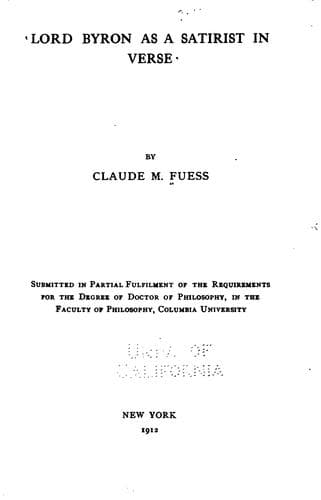
Lord Byron as a satirist in verseFuess, Claude Moore
History
Lord Byron as a satirist in verse
Fuess, Claude Moore
Byron, George Gordon Byron, Baron, 1788-1824 -- Criticism and interpretation; Verse satire, English -- History and criticism
In form the satire is a closet drama in two acts, each containing
approximately 160 lines. The characters represented are intended, in
many instances, for living persons. Thus, in the first act, which takes
place before the door of a lecture room, Inkel, who is apparently
Byron, converses with Tracy, who may be Moore. Within, Scamp, probably
Hazlitt, is delivering a discourse to a crew of “blues, dandies,
dowagers, and second-hand scribes.” Among the subjects for discussion
between the two men is Miss Lilac, a spinster, and heiress, and a
Blue, who is doubtless a caricature of Miss Milbanke, the later Lady
Byron. References to “Renegado’s Epic,” “Botherby’s plays,” and “the
_Old Girl’s Review_” indicate that Byron has returned to some favorite
subjects for his satire.
The second act is located at the home of Lady Bluebottle, who resembles
closely Lady Holland, the well-known Whig hostess and one of Byron’s
friends. Sir Richard Bluebottle, in a monologue, complains of the crowd
of,
“Scribblers, wits, lecturers, white, black, and blue,”
who invade his house and who are provided for at his expense. In the
scene which ensues, Inkel acts as a sort of interlocutor, with the
others as a chorus. Wordsworth, the “poet of peddlers,” is satirized in
the old fashion of _English Bards_ as the writer who,
“Singing of peddlers and asses,
Has found out the way to dispense with Parnassus.”
Southey is referred to as “Mouthy.” Of the other figures, Lady Bluemont
is, perhaps, Lady Beaumont, and Miss Diddle, Lydia White, “the
fashionable blue-stocking.” When the party breaks up, Sir Richard is
left exclaiming,
“I wish all these people were damned with my marriage.”
On May 6, 1823, Byron finished Canto XVI of _Don Juan_. The fourteen
extant stanzas of Canto XVII are dated May 8th. Shortly after he made
preparations for his expedition to Greece, and, on July 23, 1823,
sailed in the _Hercules_, with Gamba and Trelawney, for Cephalonia.
From this time on, his work in poetry practically ceased. He wrote
Moore from Missolonghi, March 4, 1824: “I have not been quiet in an
Ionian Island but much occupied with business.... Neither have I
continued _Don Juan_, or any other poem.”[381] He devoted himself
to drilling Greek troops, holding conferences with leaders, and
corresponding with the patriot parties. A fever, brought on by
over-exposure, attacked him on April 11th, on the 19th, he died. His
remains were brought to England, and buried in the little church of
Hucknall Torquard, only a few miles from Newstead Abbey.
CONCLUSION
Public-domain text, read in full here on John Shaqi.
Reviews
Reviews
No reviews yet
Be the first to share your thoughts on this work.
Elsewhere in the archive
Join the Discussion
Join the discussion
Sign in to leave a comment or review.
Sign InorCreate an account