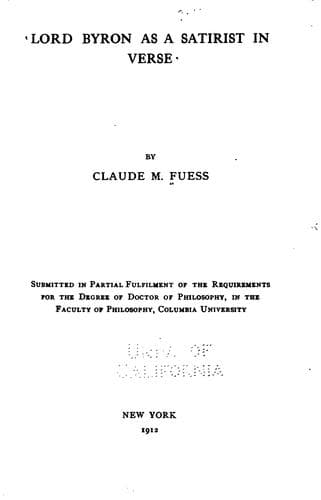
Lord Byron as a satirist in verseFuess, Claude Moore
History
Lord Byron as a satirist in verse
Fuess, Claude Moore
Byron, George Gordon Byron, Baron, 1788-1824 -- Criticism and interpretation; Verse satire, English -- History and criticism
Most of the characteristics which make up this personality accountable
for Byron’s satiric spirit have been brought out and discussed in
previous chapters. The most important of all, probably, is the haste
and impetuosity with which he was accustomed to act. In this respect
he may be again contrasted with Dryden, who proceeded to satirize an
enemy after due preparation, without apparent agitation or excitement,
much as a surgeon performs a necessary operation. Even Pope, sensitive
and irritable though he was, did not usually strike when his temper
was beyond his control. Byron, on the other hand, was, in most cases,
feverish and impulsive; what he thought to be provocation was followed
at once by a blow. He did not adopt a position of unmoved superiority,
but, both too proud and too impatient to delay, sought instinctively to
settle a dispute on the spot. Except in some instances notable because
of their rarity, Byron seems to have had no understanding of the
method of toying with a prospective victim; he planned to close with
his opponent, to meet him in a grapple, and to overwhelm him by sheer
energy and intrepidity.
This want of restraint had, of course, some favorable results on his
satire; the work was indisputably vigorous, effective because of the
ungoverned passion which sustained it. At the same time this hasty
action was detrimental to Byron’s art, and accounts, in part, for the
frequent lack of subtlety in his satire. We may be roused temporarily
by the fury of the lines; but when, in less enthusiastic moods, we
examine the details, we miss the technique and the transforming
craftsmanship of the supreme artist. Only in _The Vision of Judgment_
did he devote himself to devising means for gaining his end in the most
dexterous fashion; and the consequence is that poem is the finest of
his satires. In the earlier satires we have Byron, the man, talking
out spontaneously, angrily, unguardedly, without second thought or
reconsideration, like Churchill, a mighty wielder of the bludgeon but a
poor master with the rapier.
Byron’s satiric spirit was always combative rather than argumentative
or controversial. He preferred to assail men rather than principles.
When he disliked an institution or a party, his invariable custom was
to select some one as its representative and to proceed to call him to
account. It is this desire to war with persons and not with theories
that explains his attacks on Castlereagh, whom he never knew, but whom
he singled out as the embodiment of England’s repressive policy. By
nature Byron was much more ready to quarrel with the Foreign Minister
as an individual than he was to discuss the prudence and expediency of
that statesman’s measures.
Public-domain text, read in full here on John Shaqi.
Reviews
Reviews
No reviews yet
Be the first to share your thoughts on this work.
Elsewhere in the archive
Join the Discussion
Join the discussion
Sign in to leave a comment or review.
Sign InorCreate an account