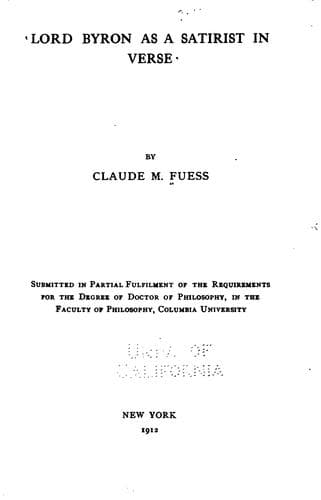
Lord Byron as a satirist in verseFuess, Claude Moore
History
Lord Byron as a satirist in verse
Fuess, Claude Moore
Byron, George Gordon Byron, Baron, 1788-1824 -- Criticism and interpretation; Verse satire, English -- History and criticism
The characteristics so far mentioned could belong only to a daring and
fearless man. Byron never hesitated to avow his ideas, nor did he ever
retract his invective except in cases in which he had been convinced
that he was unjust. He published the _Lines to a Lady Weeping_ under
his own name at a time when no one suspected his authorship. For years
he satirized European sovereigns without showing the slightest sign
of trepidation. He espoused unpopular causes, and often, of his own
choice, ran close to danger, when mere silence would have assured him
security.
But despite the fact that Byron’s hatreds were seldom disguised and
that he was, on the whole, open and manly in his satire, there is
another side to his nature which cannot be left unnoticed. He was,
unfortunately, implicated in certain incidents which leave him under
the suspicion of a kind of treachery towards his friends. His lampoon
on Samuel Rogers, beginning,
“Nose and chin would shame a knocker;
Wrinkles that would puzzle Cocker;”
and ending,
“For his merits, would you know ’em?
Once he wrote a pretty Poem,”
unpublished during his lifetime, was nevertheless a malicious squib
directed at a man who had been one of his closest companions. There
can be no doubt, too, that Byron’s satiric ballad on Hobhouse, “My boy
Hobbie, O,” sent secretly to England, was a true stab in the back,
administered to the man who had been his loyal friend. Byron, moreover,
was not always accurate in his charges. Like most satirists, he
exaggerated to gain his point, and made claims which the evidence did
not justify. Nor is it in his favor that he chose to attack his wife in
public lampoons, and wrote scurrilous epigrams upon dead statesmen.
This lack of delicacy aside, however, it must be recognized that
Byron’s satire was often exerted in condemning real evils, and that
he performed a definite service to humanity. More than any other man
of his time he insisted on liberty of speech and action in a period
when reactionary politicians were in the ascendant. He combated the
perennial forms of hypocrisy and cant which appear constantly in
England. Neither Dryden nor Pope had been the consistent champion of
great causes; but Byron so often employed his satire for beneficial
purposes that, despite the vituperation with which it was greeted by
conservatives, it became a powerful influence for good.
Public-domain text, read in full here on John Shaqi.
Reviews
Reviews
No reviews yet
Be the first to share your thoughts on this work.
Elsewhere in the archive
Join the Discussion
Join the discussion
Sign in to leave a comment or review.
Sign InorCreate an account