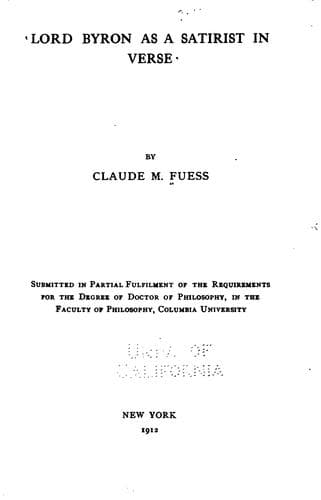
Lord Byron as a satirist in verseFuess, Claude Moore
History
Lord Byron as a satirist in verse
Fuess, Claude Moore
Byron, George Gordon Byron, Baron, 1788-1824 -- Criticism and interpretation; Verse satire, English -- History and criticism
Since Byron was a radical and a rebel, his satire was devoted, so far
as it concerned itself with political questions, to the glorification
of liberty in all its forms, and to the vigorous denunciation of
everybody and everything that tended to block or discourage progressive
movements. In defence of freedom and in resistance to oppression, his
satire found its fullest mission and its amplest justification. When
continental Europe of the middle nineteenth century thought of Byron,
it pictured him as a nobleman who had assailed tyrannical monarchy, who
had aided Italy and Greece in their struggles for independence, and who
had been willing to fight for the sake of the principles in which he
believed. The words of Byron’s political creed have a noble ring: “The
king-times are fast finishing. There will be blood shed like water, and
tears like mist; but the peoples will conquer in the end. I shall not
live to see it, but I foresee it.”
The broader philosophical satire on humanity in which he was more
and more inclined to indulge as he reached maturity is essentially
shallow and cynical. As soon as Byron became indefinite, as soon as he
undertook to preach, he grew unsatisfactory, for he had no lesson to
teach beyond the pessimism of _Ecclesiastes_.
All these objects for satire afforded Byron an opportunity for
expressing some much-needed criticism. The most unworthy sections of
his satire are those devoted to mere revenge: the unchivalric lines on
Lady Byron and Mrs. Clermont; the violent abuse of Southey and Jeffrey;
and the treacherous thrusts at Rogers and Hobhouse. In these passages
the satirist descends to the lower level of Churchill and Gifford.
It remains to say a word of Byron’s methods, a word merely of
recapitulation. Preferring directness always, he was inclined by nature
to go straight to his goal, to speak his mind out without pausing to
devise subtle or devious plans of attack. Except in his Italian satires
his procedure was simple enough: he hurled epithets, made scandalous
and scurrilous charges, and thought out offensive comments, writing
usually in the first person and meeting his enemies face to face in the
good old way of his eighteenth century predecessors. It is, perhaps,
unsafe, with _Don Juan_ and _The Vision of Judgment_ before us, to
assert that he was incapable of finesse and cunning; but, for the most
part, even in these poems, he was more fond of abuse than he was of
innuendo and crafty insinuation. His impetuosity and irrepressible
impulsiveness, to which we have had occasion so often to refer, did not
allow him to dwell scrupulously on artistic effects.
Public-domain text, read in full here on John Shaqi.
Reviews
Reviews
No reviews yet
Be the first to share your thoughts on this work.
Elsewhere in the archive
Join the Discussion
Join the discussion
Sign in to leave a comment or review.
Sign InorCreate an account