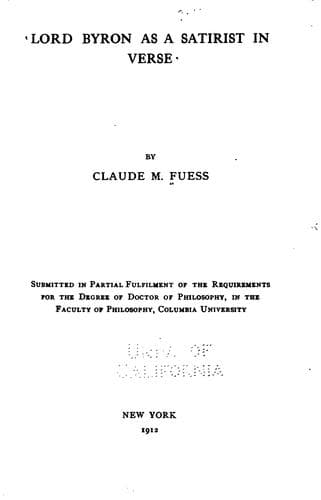
Lord Byron as a satirist in verseFuess, Claude Moore
History
Lord Byron as a satirist in verse
Fuess, Claude Moore
Byron, George Gordon Byron, Baron, 1788-1824 -- Criticism and interpretation; Verse satire, English -- History and criticism
He had, however, two distinct satiric moods: the one, savage, stern,
and merciless; the other, mocking, scornful, and humorous. The one
resulted in invective, the other, in ridicule and burlesque. One came
to him from Juvenal, Pope, and Gifford; the other he learned from
Moore, Frere, and the Italians. Thanks to his versatility, he was
successful in using both; but his real genius was shown more in the
contemptuous mirth of _The Vision of Judgment_ than in the fury of
_English Bards_.
Unlike Pope, Byron was no adept at framing pointed phrases. The
beauty of Pope’s satire lies in the single lines, in the details and
the finish of an epithet. Byron’s work, on the other hand, should be
estimated with regard to the general effect. Few recall particular
lines from the passage on Southey in _The Vision of Judgment_; yet
every one remembers the complete caricature of the laureate. Pope
manipulated a delicate and fine stencil; Byron painted on the canvas
with broad sweeping strokes.
Byron was the last of the great English satirists in verse, and he
has had no imitators who have been able to approach his unique style
and manner. It is a curious fact that his influence after his death
on nineteenth-century English satire has been almost negligible. The
causes of this decline in satire since Byron’s day are not altogether
easy to explain. Perhaps it may be accounted for as accompanying the
general lack of interest in poetry of any sort so common to-day.
Possibly it may be due to the stringency of the laws against libel,
which has resulted in the situation described by Sir George Trevelyan
in his _Ladies in Parliament_:
“But now the press has squeamish grown, and thinks invective rash:
And telling hits no longer lurk ’neath asterisk and dash;
And poets deal in epithets as soft as skeins of silk,
Nor dream of calling silly lords a curd of ass’s milk.”
In the twentieth century great political problems are usually fought
out in the newspapers or in prose pamphlets; the editorials of our
daily journals take the place of satires like _The Age of Bronze_.
Doubtless, too, we have grown somewhat refined in our sensibilities
and fastidious in our speech, so that we shrink from the cut-and-slash
method in poetry. At any rate our English satire since 1830 has
inclined toward raillery and humor, wholly unlike the ardent
vindictiveness of the men under the Georges. The old régime died away
with Byron; and in its stead we have had the polished cleverness of
Praed, the gentle cynicism of Thackeray, the mild sentimentality
of Looker and Dobson. Not until very recently have flashes of the
invective spirit appeared in the work of William Watson and Rudyard
Kipling. The great issues of the twentieth century have stimulated no
powerful English satirist in verse.
BIBLIOGRAPHY
Public-domain text, read in full here on John Shaqi.
Reviews
Reviews
No reviews yet
Be the first to share your thoughts on this work.
Elsewhere in the archive
Join the Discussion
Join the discussion
Sign in to leave a comment or review.
Sign InorCreate an account