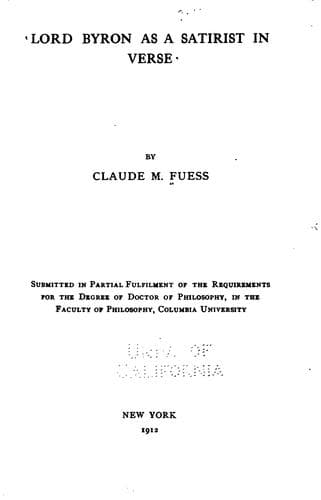
Lord Byron as a satirist in verseFuess, Claude Moore
History
Lord Byron as a satirist in verse
Fuess, Claude Moore
Byron, George Gordon Byron, Baron, 1788-1824 -- Criticism and interpretation; Verse satire, English -- History and criticism
WEDDIGEN, O. _Lord Byrons Einfluss auf die
europaischen Litteraturen der
Neuzeit_, Hannover, 1884.
FOOTNOTES
[1] That satire is primarily destructive criticism was asserted by
Heinsius in a familiar passage quoted approvingly by Dryden in his
_Essay on Satire_:--“Satire is a kind of poetry--in which human vices,
ignorance, and errors, and all things besides, which are produced
from them in every man, are severely reprehended.” The same theory is
expressed by De Gubernatis in his _Storia della Satira_:--“La satira è,
sovra ogni cosa, una negazione.”
[2] See _Poetry_, VII, 1.
[3] In the Preface to _Absalom and Achitophel_, Dryden is inclined to
take pride in his fairness:--“I have but laughed at some men’s follies,
when I could have declaimed against their vices; and other men’s
virtues I have commended, as freely as I have taxed their crimes.”
[4] _Epilogue to the Satires_, Dialogue II., 212–217.
[5] See Chesterton’s _Pope and the Art of Satire_.
[6] Both methods are illustrated in a line of the _Dunciad_:--
“My H--ley’s periods, or my Blackmore’s numbers.”
[7] In the Dramatis Personæ of _Absalom and Achitophel_ only two women
appear, and they are spoken of in the poem in a complimentary way.
[8] Byron particularly emphasizes the correctness and moral tone of
Pope: he is “the most perfect of our poets and the purest of our
moralists” (_Letters_, v., 559); “his moral is as pure as his poetry is
glorious” (_Letters_, v., 555); “he is the only poet that never shocks”
(_Letters_, v., 560).
[9] Gay’s _Alexander Pope, his safe Return from Troy_ (1720) is
interesting as being one of the rare examples of the use of the English
octave stanza between _Lycidas_ and _Beppo_.
[10] _Letters_, v., 252.
[11] In speaking of the art of rhyming to Trelawney, Byron said:--“If
you are curious in these matters, look in Swift. I will send you a
volume; he beats us all hollow, his rhymes are wonderful.”
[12] Cf. Swift’s _The Puppet Show_ with Byron’s _Inscription on the
Monument of a Newfoundland Dog_.
[13] For a contemporary characterization of the unscrupulous satirists
of the period see Cowper’s _Charity_, 501–532, in the passage beginning,
“Most satirists are indeed a public scourge.”
[14] Examples are _The Thimble_ (1743) by William Hawkins (1722–1801)
and the _Scribleriad_ (1752) by Richard Owen Cambridge (1717–1802).
[15] _State Dunces_ (1733) and _The Gymnasiad_ (1738) by Paul Whitehead
(1710–1744); _The Toast_ (1736) by William King (1685–1763); and a
succession of anonymous poems, _The Battle of the Briefs_ (1752),
_Patriotism_ (1765), _The Battle of the Wigs_ (1763), _The Triumph of
Dulness_ (1781), _The Rape of the Faro-Bank_ (1797), and _The Battle of
the Bards_ (1799).
Public-domain text, read in full here on John Shaqi.
Reviews
Reviews
No reviews yet
Be the first to share your thoughts on this work.
Elsewhere in the archive
Join the Discussion
Join the discussion
Sign in to leave a comment or review.
Sign InorCreate an account