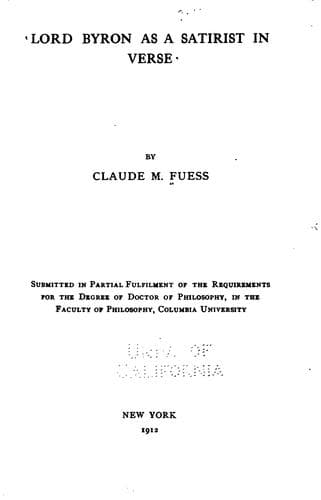
Lord Byron as a satirist in verseFuess, Claude Moore
History
Lord Byron as a satirist in verse
Fuess, Claude Moore
Byron, George Gordon Byron, Baron, 1788-1824 -- Criticism and interpretation; Verse satire, English -- History and criticism
[16] The most important is Churchill’s _Rosciad_ (1761), with the
numerous replies which it elicited: the _Churchilliad_ (1761), the
_Smithfield Rosciad_ (1761), the _Anti-Rosciad_ (1761), by Thomas
Morell (1703–1784), and _The Rosciad of Covent Garden_ (1761) by
H. J. Pye (1745–1813). Among other satires of the same class may be
mentioned the _Smartiad_ (1752) by Dr. John Hill (1710–1775), with its
answer, the severe and effective _Hilliad_ (1752) by Christopher Smart
(1722–1771); the _Meretriciad_ (1764) by Arthur Murphy (1727–1806); the
_Consuliad_ (1770), a fragment by Chatterton; the _Diaboliad_ (1777),
with its sequel, the _Diabolady_ (1777) by William Combe (1741–1823);
and finally the _Criticisms on the Rolliad_, Gifford’s _Baviad_ and
_Mæviad_, the _Simpliciad_, and the _Alexandriad_ (1805).
[17] _The Scandalizade_ (1750); _The Pasquinade_ (1752) by William
Kenrick (1725–1779); _The Quackade_ (1752); _The Booksellers_ (1766);
_The Art of Rising in the Church_ (1763) by James Scott (1733–1814);
_The Senators_ (1772); and _The Tribunal_ (1787).
[18] A few typical controversial satires of this decade are: _The
Race_ (1762) by Cuthbert Shaw (1739–1771); _The Tower_ (1763); _The
Demagogue_ (1764) by William Falconer (1732–1769); _The Scourge_
(1765); and _The Politician_ (1766) by E. B. Greene (1727–1788).
[19] Some characteristic examples are the _Epistle to Cornbury_ (1745)
by Earl Nugent (1702–1788); the _Epistle to William Chambers_ (1773)
and the _Epistle to Dr. Shebbeare_ (1777) by William Mason (1724–1797);
and the _Epistle to Dr. Randolph_ (1796), as well as numerous other
epistles, by T. J. Mathias.
[20] See Macaulay’s _Essay on Horace Walpole_, page 35.
[21] _An Essay on the Different Styles of Poetry_ (1713) by Thomas
Parnell (1679–1718); _The Danger of Writing Verse_ (1741) by William
Whitehead (1715–1785); _A Prospect of Poetry_ (1733); _The Perils of
Poetry_ (1766); and _The Wreath of Fashion_ (1780) by Richard Tickell
(1751–1793).
[22] The anonymous _Manners of the Age_ (1733); _Manners_ (1738)
by Paul Whitehead; _The Man of Taste_ (1733) by James Bramston
(1694–1744); the _Modern Fine Gentleman_ (1746) and the _Modern Fine
Lady_ (1750) by Soame Jenyns (1703–1787); _Fashion_ (1748) by Joseph
Warton (1722–1800); and _Newmarket_ (1751) by Thomas Warton (1728–1790).
[23] Examples are the _Essay on Reason_ (1733) by Walter Harte
(1709–1774); the _Vanity of Human Enjoyments_ (1749) by James Cawthorn
(1718–1761), the most slavish of all Pope’s imitators; _Honour_
(1737) by John Brown; _Advice_ and _Reproof_ (1747) by Smollett;
_Of Retired and Active Life_ (1735) by William Helmoth (1710–1799);
_Ridicule_ (1743) by William Whitehead; _Taste_ (1753) by John
Armstrong (1709–1779); _An Essay on Conversation_ (1748) by Benjamin
Stillingfleet (1702–1771).
[24] _Letters_, v., 162.
[25] _Letters_, iv., 485.
[26] See _An Apology_, 376–387.
Public-domain text, read in full here on John Shaqi.
Reviews
Reviews
No reviews yet
Be the first to share your thoughts on this work.
Elsewhere in the archive
Join the Discussion
Join the discussion
Sign in to leave a comment or review.
Sign InorCreate an account