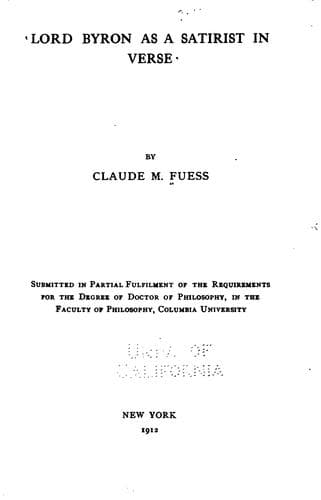
Lord Byron as a satirist in verseFuess, Claude Moore
History
Lord Byron as a satirist in verse
Fuess, Claude Moore
Byron, George Gordon Byron, Baron, 1788-1824 -- Criticism and interpretation; Verse satire, English -- History and criticism
[183] Frere was well known in 1817 as a prominent London wit. His
career as a diplomat, which apparently promised him high preferment,
had been cut short by some unlucky transactions leading to his being
held partly responsible for the failure of the Peninsular campaign, and
he had been recalled in 1809 from his position as envoy to Ferdinand
VII. of Spain. The incident drew upon him Byron’s lines on “blundering
Frere” in some expunged stanzas of _Childe Harold_, I. Piqued by the
action of the government and constitutionally inclined to inactivity,
Frere had since led an indolent and self-indulgent existence as scholar
and clubman.
[184] Dr. Eichler finds that Frere drew something from Aristophanes
and Cervantes, but more from Pulci, Berni, and Casti. For Frere’s
indebtedness to the Italians, see Eichler’s _Frere_, 115.
[185] _Letters_, iv., 172.
[186] _Letters_, iv., 176.
[187] While it is undisputed that the ottava rima is a native Italian
stanza, its origin has never been satisfactorily determined. That
it was a common measure before the time of Boccaccio is easily
demonstrable; but it is equally probable that he, in his _Teseide_, was
the earliest writer to employ it consciously for literary purposes.
With him it assumed the form which it was to preserve for centuries:
eight endecasyllabic lines, rhyming abababcc. In Pulci’s _Morgante
Maggiore_ it became freer and less dignified, without losing any of its
essential characteristics. Pulci made ottava rima the standard measure
for the Italian romantic epic and burlesque, and it was used by men
differing so greatly in nature and motive as Boiardo, Berni, Tasso,
Marino, Tassoni, Forteguerri, and Casti. To the Italian language, rich
in double and triple rhymes, it is especially well suited; and its
elasticity is proved by its effective employment in both the lofty epic
of Tasso and the vulgar verse of Casti.
Public-domain text, read in full here on John Shaqi.
Reviews
Reviews
No reviews yet
Be the first to share your thoughts on this work.
Elsewhere in the archive
Join the Discussion
Join the discussion
Sign in to leave a comment or review.
Sign InorCreate an account