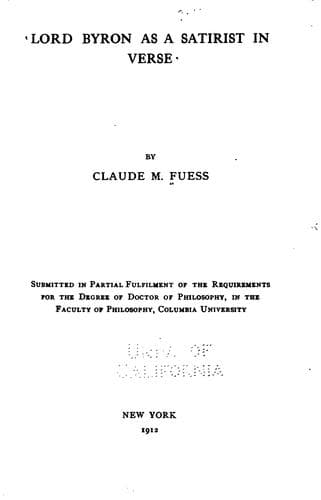
Lord Byron as a satirist in verseFuess, Claude Moore
History
Lord Byron as a satirist in verse
Fuess, Claude Moore
Byron, George Gordon Byron, Baron, 1788-1824 -- Criticism and interpretation; Verse satire, English -- History and criticism
[152] Byron expressed his esteem for his new friend in his Journal,
December 10, 1813:--“I have just had the kindest letter from Moore.
I _do_ think that man is the best-hearted, the only _hearted_ being
I ever encountered; and then, his talents are equal to his feelings”
(_Letters_, ii., 371).
[153] See Byron’s impromptu lines to Moore in a letter of May 19, 1812,
in which he says, speaking of a projected visit to Hunt in prison:--
“Pray Phœbus at length our political malice
May not get us lodgings within the same palace.”
(_Letters_, ii., 204–209.)
[154] See _Letters_, ii., 463–492 (Appendix vii.).
[155] _Letters_, iii., 61.
[156] _Letters_, ii., 134.
[157] _The Real Lord Byron_, ii., 51.
[158] On December 2, 1813, Byron wrote Hunt:--“I have a thorough esteem
for that independence of spirit which you have maintained with sterling
talent, and at the expense of some suffering” (_Letters_, ii., 296).
[159] _Letters_, iii., 58.
[160] Byron’s attitude towards war recalls the sardonic passage on the
same subject in _Gulliver’s Travels_, Part IV.
[161] _Letters_, iii., 64.
[162] _Letters_, iii., 66.
[163] _Letters_, ii., 324.
[164] _Childe Harold_, III., 36–52.
[165] _Letters_, ii., 176.
[166] _Letters_, ii., 202.
[167] Byron himself was asked to compete, but resolved not to risk his
reputation in such a contest. Although 112 poems were submitted, all
were adjudged unsatisfactory, and Byron was eventually requested by
Lord Holland to save the situation. His verses were recited on October
10, 1812, but met with small commendation.
[168] This little volume, published in 1812, after having been
refused by Murray and others, proved an overwhelming success. Byron
was delighted with _Cui Bono?_ a clever imitation of the gloomy and
mournful portions of _Childe Harold_, in the same stanzaic form. Among
the other writers parodied were Wordsworth, Crabbe, Moore, Coleridge,
and Lewis. Byron said:--“I think the _Rejected Addresses_ by far the
best thing of the kind since the _Rolliad_” (_Letters_, ii., 177).
[169] Byron himself said of this period:--“I felt that, if what was
whispered and murmured was true, I was unfit for England; if false,
England was unfit for me” (_Reply to Blackwood’s_, _Letters_, iv., 479).
[170] _Letters_, iii., 272.
[171] _Letters_, iii., 278.
[172] _Childe Harold_, I., 26.
[173] _Childe Harold_, I., 69–70.
[174] _Childe Harold_, I., 9.
[175] _Letters_, i., 308.
[176] _Letters_, ii., 5.
[177] See _Letters_, ii., 413 (Appendix i.).
[178] _Letters_, ii., 379; ii, 403.
[179] See Fuhrman’s _Die Belesenheit des jungen Byron_, Berlin, 1903.
[180] _Letters_, iii., 19.
[181] _Letters_, v., 70.
[182] _Life of Byron_, iv., 237.
Public-domain text, read in full here on John Shaqi.
Reviews
Reviews
No reviews yet
Be the first to share your thoughts on this work.
Elsewhere in the archive
Join the Discussion
Join the discussion
Sign in to leave a comment or review.
Sign InorCreate an account