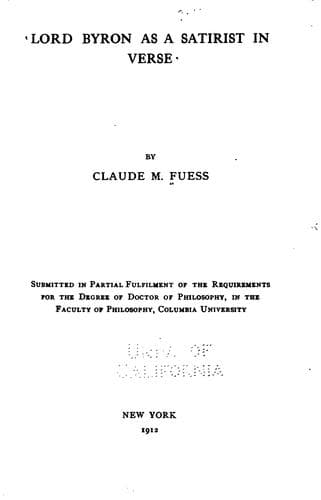
Lord Byron as a satirist in verseFuess, Claude Moore
History
Lord Byron as a satirist in verse
Fuess, Claude Moore
Byron, George Gordon Byron, Baron, 1788-1824 -- Criticism and interpretation; Verse satire, English -- History and criticism
[194] _Letters_, iv., 193.
[195] _The Monks, and the Giants_, III., 59.
[196] Eichler’s _Frere_, 184.
[197] In his _Studies in Poetry and Criticism_ (London, 1905), Churton
Collins pointed out Byron’s indebtedness to Casti, but mentioned only
Casti’s _Novelle_. See Collins’s volume, pp. 96–98.
[198] Eichler’s _Frere_, 163.
[199] _Letters_, iv., 217.
[200] Born in 1721 in Italy, Casti had been a precocious student at
the seminary of Montefiascone, where he became Professor of Literature
at the age of sixteen. In 1764 he moved, with the musician, Guarducci,
to Florence, where he was created Poeta di Corte by the Grand Duke
Leopold. Here he came to the attention of Joseph II., who invited
him to Vienna and bestowed upon him several posts of honor. A lucky
friendship with Count Kaunitz enabled him to visit most of the capitals
of Europe in company with that Prime Minister’s son, and he gained in
this way an inside knowledge of court life in several countries. In
1778 he took up his residence in St. Petersburg, where Catharine II.
received him cordially. Later he returned to Vienna and was crowned
Court Poet by the Emperor Leopold. The attraction of the French
Revolution drew him to Paris in 1796, where he lived until his death,
February 16, 1804.
[201] _Quarterly Review_, April, 1819.
[202] Churton Collins, however, makes the statement that “_Don Juan_
is full of reminiscences of the _Novelle_,” and points out definite
parallelisms between Novella IV., _La Diavolessa_, and the plot of
_Don Juan_. He adds: “To Casti, then, undoubtedly belongs the honour
of having suggested and furnished Byron with a model for _Don Juan_.”
(_Studies in Poetry and Criticism_, pp. 97–98.) It seems probable,
however, that Byron took even more from _Il Poema Tartaro_ than he
did from the _Novelle_. Casti’s _Gli Animali Parlanti_ and _Il Poema
Tartaro_ are not mentioned in Collins’s study.
[203] To this work Byron refers in a letter to Murray, March 25,
1818: “Rose’s _Animali_ I never saw till a few days ago,--they are
excellent.” (_Letters_, iv., 217.)
[204] _Gli Animali Parlanti_, VII., 6 ff.
[205] _Ibid._, III., 37.
[206] _Ibid._, III., 32.
[207] _Ibid._, XX., 69.
[208] _Ibid._, XIV., 47; XVII., 36, 56.
[209] _Gli Animali Parlanti_, I., 52.
[210] _Don Juan_, X., 25.
[211] _Gli Animali Parlanti_, XVIII., 33.
[212] _Don Juan_, VII., 68.
[213] _Gli Animali Parlanti_, IV., 13.
[214] _Don Juan_, XIV., 13. See also _Gli Animali Parlanti_, X., 1;
XVIII., 32, and _Don Juan_, VII., 26, 41; VIII., 124.
[215] _Gli Animali Parlanti_, IV., 73.
[216] _Don Juan_, XV., 19. See also _Gli Animali Parlanti_, III., 95;
VII., 38; _Don Juan_, VI., 8; VIII., 89; _The Vision of Judgment_, 34.
[217] _Gli Animali Parlanti_, IV., 107.
[218] _Don Juan_, I., 231. See also _Gli Animali Parlanti_, XX., 126,
and _Don Juan_, IV., 117; V., 159; VI., 120; VII., 35; IX., 85; XV., 98.
Public-domain text, read in full here on John Shaqi.
Reviews
Reviews
No reviews yet
Be the first to share your thoughts on this work.
Elsewhere in the archive
Join the Discussion
Join the discussion
Sign in to leave a comment or review.
Sign InorCreate an account