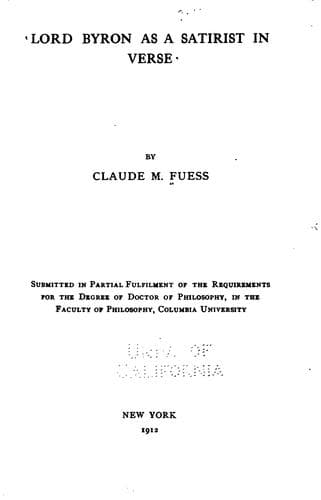
Lord Byron as a satirist in verseFuess, Claude Moore
History
Lord Byron as a satirist in verse
Fuess, Claude Moore
Byron, George Gordon Byron, Baron, 1788-1824 -- Criticism and interpretation; Verse satire, English -- History and criticism
[219] In _Childe Harold_ the digression had been used, not for satire,
but for personal reminiscences, eulogy, and philosophical meditation;
see Canto I., 91–92, with its tribute to Wingfield, and Canto I., 93,
with its promise of another canto to come.
[220] _Il Poema Tartaro_, II., 8.
[221] _Don Juan_, IX., 62.
[222] _Il Poema Tartaro_, IV., 76.
[223] _Don Juan_, IX., 81. See also _Don Juan_, IX., 80.
[224] _Il Poema Tartaro_, I., 5.
[225] See _Il Poema Tartaro_, IV., 54–55, and _Don Juan_, IX., 82.
[226] See _Il Poema Tartaro_, V., 32 ff., and _Don Juan_, X., 39.
[227] See _Il Poema Tartaro_, VIII., 85, and _Don Juan_, VII., 14–15.
[228] See _Il Poema Tartaro_, III., 81, and _Don Juan_, III., 20; X.,
69.
[229] _Il Poema Tartaro_, VI., 98.
[230] _Don Juan_, VII., 18.
[231] _Il Poema Tartaro_, VIII., 12.
[232] _Ibid._, III., 68.
[233] _Ibid._, IV., 69.
[234] _Il Poema Tartaro_, VI., 47.
[235] _Ibid._, XII., 79.
[236] _Letters_, iv., 217.
[237] _Letters_, iv., 407.
[238] In structure, the _Morgante Maggiore_, is made up of the
_rifacimenti_ of two earlier works: one, the _Orlando_, rather
commonplace and monotonous in tone, was the basis of the first
twenty-three cantos; the other, _La Spagna_, in prose, loftier and more
stately, gave a foundation for the last five cantos.
[239] _Don Juan_, IV., 6.
[240] It is probable that Byron had read Merivale’s poem, _Orlando
in Roncesvalles_ (1814), for in the advertisement to his translation
of Pulci he refers to “the serious poems on Roncesvalles in the
same language [English]--and particularly the excellent one of Mr.
Merivale.” Merivale’s work, based though it is upon the _Morgante_,
is without humor, and could have given Byron nothing of the spirit of
Pulci.
[241] _Letters_, iv., 402.
[242] _Letters_, iv., 407.
[243] Cantos III. and IV. of _Don Juan_ were written in the winter
of 1819–1820, while Byron was at work on his translation of the
_Morgante_; hence it is certain that the influence of Pulci may be
looked for at least as early as Canto III. It is probable, moreover,
that Byron became acquainted with Pulci’s work before, or soon after,
the beginning of _Don Juan_ in September, 1818.
[244] _Don Juan_, X., 87.
[245] _Don Juan_, VII., 55.
[246] _Morgante Maggiore_, XIV., 7.
[247] _Ibid._, III., 51.
[248] _Ibid._, XI., 21.
[249] _Don Juan_, II., 92.
[250] _Morgante Maggiore_, XVIII., 117.
[251] _Ibid._, XVIII., 144.
[252] _Don Juan_, XII., 50.
[253] _Morgante Maggiore_, XXIV., 83.
[254] _Don Juan_, XII., 88.
[255] _Morgante Maggiore_, XXVIII., 138–9.
[256] _Don Juan_, XV., 19.
[257] _Ibid._, V., 159.
[258] Other examples occur in the _Morgante Maggiore_, I., 4; II., 1;
XIV., 1; XVI., 1; XXI., 1; XXIV., 1; XXVIII., 1.
[259] _Don Juan_, X., 4.
[260] _Morgante Maggiore_, I., 8.
[261] _Morgante Maggiore_, XXV., 283.
[262] _Ibid._, XXVIII., 35.
[263] _Don Juan_, XV., 20.
Public-domain text, read in full here on John Shaqi.
Reviews
Reviews
No reviews yet
Be the first to share your thoughts on this work.
Elsewhere in the archive
Join the Discussion
Join the discussion
Sign in to leave a comment or review.
Sign InorCreate an account