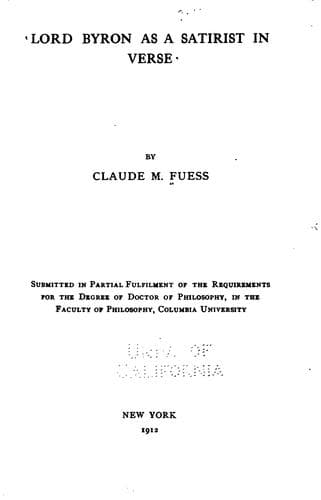
Lord Byron as a satirist in verseFuess, Claude Moore
History
Lord Byron as a satirist in verse
Fuess, Claude Moore
Byron, George Gordon Byron, Baron, 1788-1824 -- Criticism and interpretation; Verse satire, English -- History and criticism
[273] There is less of the mock-heroic in _Don Juan_ than is ordinarily
supposed. It has little in common with the classical Mock-Epic,
represented in English by the _Dunciad_, the _Scribleriad_, and the
_Dispensary_, poems which use the epic machinery of gods and goddesses,
ridiculing the manner of the Greek and Roman epics through the method
of parody. _Don Juan_, on the other hand, is unrelated to the work
of either Homer or Virgil. Nor does it burlesque the Italian epics:
its characters, modern and unconventional as they are, are not, even
in a humorous sense, heroic, and the matter dealt with is borrowed
from none of the Italian romances. The fact that exalted emotions are
made absurd, or that fine feelings are jeered at does not warrant us
in classing _Don Juan_ with the mock-heroic poems. Indeed, the mere
absence of the typical addresses to the Muse--they occur only twice in
_Don Juan_ (II., 7; III., 1)--indicates that Byron did not imitate the
epic form.
[274] _Letters_, vi., 50.
[275] _Letters_, iv., 217.
[276] “This poem [_Don Juan_] carries with it at once the stamp of
originality and defiance of imitation.” (Shelley, Letter to Byron, Oct.
21, 1821).
[277] _Don Juan_, II., 105; II., 166; V., 4; VI., 5–6.
[278] Ibid., V., 33–39.
[279] _Don Juan_, IX., 41.
[280] _Letters_, iv., 342.
[281] _Don Juan_, I., 200.
[282] _Don Juan_, XII., 55.
[283] _Letters_, iv., 260.
[284] _Letters_, vi., 155.
[285] _Don Juan_, XIV., 99.
[286] It was begun at Venice, September 6, 1818, and the first two
cantos were published anonymously, July 15, 1819, by Murray. Despite
much hostile comment, and the reluctance and eventual refusal of Murray
to print the work, Byron continued with his project, entrusting the
publication of the poem, after Canto V., to John Hunt. Canto XVI. was
completed May 6, 1823, and appeared with Canto XV. on March 26, 1824.
Fourteen stanzas of an unfinished Canto XVII. were among his papers at
the time of his death.
[287] _Beppo_, 79.
[288] _Don Juan_, VIII., 135.
[289] _Childe Harold_, II., 74–76.
[290] _Ode to the French_, 91–104.
[291] _Childe Harold_, IV., 92.
[292] _Don Juan_, IX., 24.
[293] _Don Juan_, VIII., 50.
[294] Many details of Byron’s satire may be traced to corresponding
passages in the works of Moore, whose _Fudge Family in Paris_ (1818)
was familiar to him, and whose _Fables for the Holy Alliance_ (1823),
many of which were written while the two poets were together in Venice,
was dedicated to Byron. Moore denounced Castlereagh as a despot, a
bigot, and a time-server, ridiculing him especially for the absurdity
of his speeches, which were notorious for their mixed metaphors and
poorly chosen phrasing.
[295] Shelley in many short squibs, and particularly in the _Mask of
Anarchy_ (1819), had assailed the ministry. He had compared Castlereagh
and Sidmouth, the Home Secretary, to “two vultures, sick for battle”
and “two vipers tangled into one” (_Similes for Two Political
Characters of 1819_).
Public-domain text, read in full here on John Shaqi.
Reviews
Reviews
No reviews yet
Be the first to share your thoughts on this work.
Elsewhere in the archive
Join the Discussion
Join the discussion
Sign in to leave a comment or review.
Sign InorCreate an account