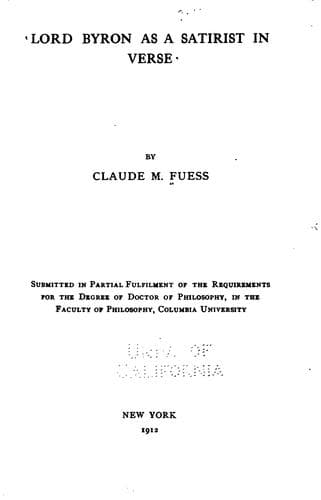
Lord Byron as a satirist in verseFuess, Claude Moore
History
Lord Byron as a satirist in verse
Fuess, Claude Moore
Byron, George Gordon Byron, Baron, 1788-1824 -- Criticism and interpretation; Verse satire, English -- History and criticism
[264] It is significant that Byron was able to make his translation
of the first canto of the _Morgante_ so faithful to the original. On
September 28, 1820, he wrote Murray:--“The Pulci I am proud of; it is
superb; you have no such translation. It is the best thing I ever did
in my life” (_Letters_, i., 83). It is obvious that there were features
in Pulci’s style which appealed to Byron.
[265] Berni was a priest, who became, with Molza, La Casa, Firenzuola,
and Bini, a member of the famous Accademia della Vignajuoli in Rome,
in which circle he was accustomed to recite his humorous poetry. He
died under suspicious circumstances, perhaps poisoned by one of the
Medicean princesses. He was the bitter enemy of Pietro Aretino, the
most scurrilous satirist of the age.
[266] See, _Don Juan_, XII., 1–22, with its discussion of avarice.
[267] See, for example, the _Innamorato_, II., 70:
“Ma s’io dicesse ogni cosa al presente
Da dire un’ altra volta non aria;
Pero tornate, e s’attenti starete,
Sempre piu belle cose sentirete.”
[268] _Don Juan_, VII., 85.
[269] Many characteristics of the _Innamorato_, however, are like those
of the work of Pulci and Casti. There are the same equivocal allusions
and obscenities, the same pervasive skepticism and pessimism, and the
same colloquial style that are to be met with in the _Morgante_ and the
_Novelle_. Berni was perhaps greater as a craftsman and artist, but
otherwise had the virtues and the faults of the other burlesque poets.
[270] _Letters_, iii., 444–445.
[271] Buratti’s career is treated at length in Vittorio Malamani’s
monograph, _Il Principe dei satirici Veneziani_ (1887). An edition of
his poetry, in two volumes, was printed in 1864.
[272] Buratti’s after-life brought him once into relation with Byron.
On the birth of a son to Hoppner, the British Consul at Venice, Byron
presented the father with a short madrigal:--
“His father’s sense, his mother’s grace,
In him, I hope, will always fit so;
With--still to keep him in good case--
The health and appetite of Rizzo.”
The Count Rizzo Pattarol, named in the last line, had the verses
translated into several languages, in the Italian version changing the
word “appetite” to “buonomore.” This piece of vanity so excited the
mirth of Buratti that he commemorated the affair in an epigram. Byron,
however, seems to have paid no attention to the incident.
Public-domain text, read in full here on John Shaqi.
Reviews
Reviews
No reviews yet
Be the first to share your thoughts on this work.
Elsewhere in the archive
Join the Discussion
Join the discussion
Sign in to leave a comment or review.
Sign InorCreate an account