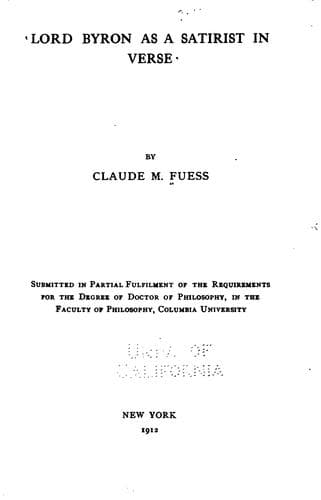
Lord Byron as a satirist in verseFuess, Claude Moore
History
Lord Byron as a satirist in verse
Fuess, Claude Moore
Byron, George Gordon Byron, Baron, 1788-1824 -- Criticism and interpretation; Verse satire, English -- History and criticism
[327] Only in Canto II. does the story begin at once; every other canto
has a preliminary disquisition. Canto IX., containing eighty-five
stanzas, uses forty-one of them before the narrative begins, and of the
entire number, forty-six are clearly made up of extraneous material. Of
the ninety stanzas in Canto XI., over fifty are occupied with Byron’s
satire on English society and contemporary events. Canto II. is, of
course, filled largely with the shipwreck and the episode of Haidée;
but in Canto III., over forty of the entire one hundred and eleven
stanzas are discursive, and many others are partly so.
[328] _Beppo_, 52.
[329] For other rhymes of exceptional peculiarity, see _Don Juan_, I.,
102; II., 206; II., 207; V., 5.
[330] _Ibid._, I., 22.
[331] _Ibid._, II., 1.
[332] _Don Juan_, I., 6.
[333] _Ibid._, III., 111.
[334] _Ibid._, XIII., 94.
[335] _Ibid._, I., 62.
[336] _Ibid._, I., 11.
[337] _Ibid._, VII., 15.
[338] _Ibid._, VII., 3.
[339] _Ibid._, XIII., 8.
[340] _Ibid._, XV., 91.
[341] _Ibid._, II., 207.
[342] _Ibid._, V., 5.
[343] _Ibid._, XIV., I. See also I., 25; I., 67; XVI., 4.
[344] _Ibid._, I., 154; II., 13, 22, 38.
[345] A characteristic example is _Ibid._, IX., 34.
[346] _Don Juan_, I., 123–124; V., 8–9; V., 18–19; VIII., 109–110.
[347] _Ibid._, I., 120.
[348] _Ibid._, XV., 72.
[349] _Ibid._, VI., 64; VII., 21; VIII., 30; XIII., 75; XIV., 29, 63;
XVI., 60, 94, 98.
[350] _Ibid._, I., 34; VI., 47; VIII., 32.
[351] _Ibid._, IV., 42.
[352] _Ibid._, VII., 27.
[353] _Don Juan_, XI., 20.
[354] _Ibid._, III., 6. See also I., 63, 65, 72; II., 172, 179; IX.,
15, 59; XIII., 6, 19.
[355] Many imitations and parodies of _Don Juan_ were printed during
Byron’s lifetime, and afterwards; among them were Canto XVII. of _Don
Juan_, by One who desires to remain a very great Unknown (1832); _Don
Juan Junior_, a Poem, by Byron’s Ghost (1839); _A Sequel to Don Juan_
(1843); _The Termination of the Sixteenth Canto of Lord Byron’s Don
Juan_ (1864), by Harry W. Wetton.
[356] Byron’s influence upon the literature of the nineteenth century
may be studied in Otto Weddigen’s treatise _Lord Byron’s Einfluss auf
die Europaischen Litteraturen der Neuzeit_ and in Richard Ackermann’s
_Lord Byron_ (pp. 158–182). Collins numbers among his disciples in
Germany, Wilhelm Mueller, Heine, Von Platen, Adalbert Chamisso, Karl
Lebrecht, Immermann, and Christian Grabbe; among his French imitators,
Lamartine, Hugo, de la Vigne, and de Musset; among his followers in
Russia, Poushkin and Lermontoff. To these should be added Giovanni
Berchet in Italy, and José de Espronceda in Spain. No other English
poet, except Shakspere, has impressed his personality so strongly upon
foreign countries.
[357] _Letters_, vi., 377–399.
Public-domain text, read in full here on John Shaqi.
Reviews
Reviews
No reviews yet
Be the first to share your thoughts on this work.
Elsewhere in the archive
Join the Discussion
Join the discussion
Sign in to leave a comment or review.
Sign InorCreate an account